Imagine a logistics firm in Maharashtra that just lost 15% of its summer harvest shipment of Alphonso mangoes. It wasn’t a transport delay, and it wasn’t a market crash. The culprit was a silent, invisible failure within their own warehouse—a subtle temperature fluctuation of just three degrees caused by a poorly sealed loading dock. For business owners in India’s rapidly expanding food processing and pharmaceutical sectors, this isn't a hypothetical nightmare; it is a daily operational risk. The difference between profit and peril often lies in the thickness of a wall panel or the integrity of a vapor barrier.
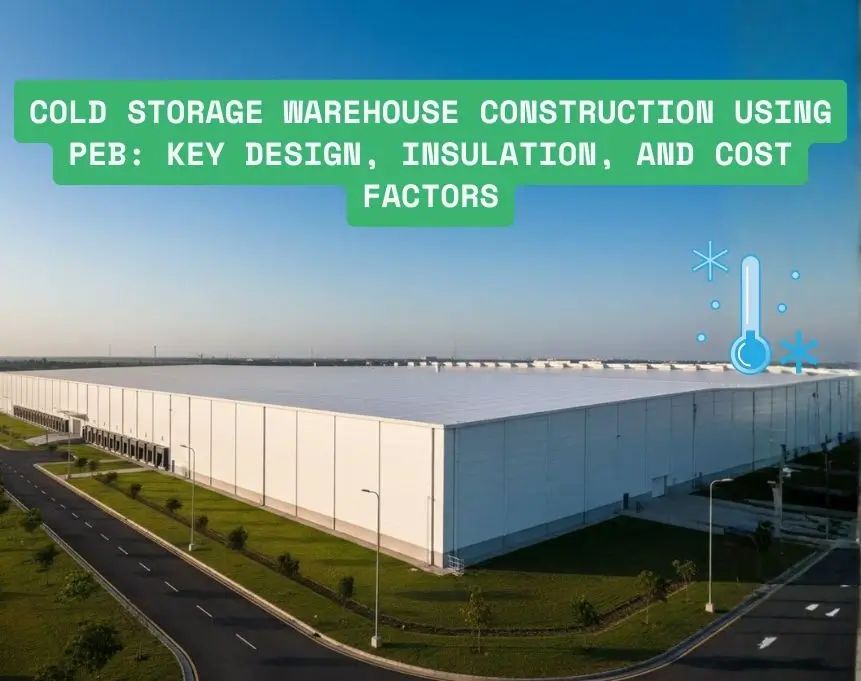
As India positions itself as a global hub for perishables and pharmaceuticals, the demand for world-class cold chain infrastructure has exploded. However, traditional construction methods simply cannot keep pace with the thermal precision and speed required by modern supply chains. This is where Pre-Engineered Buildings (PEB) have emerged not just as an alternative, but as the industry standard. At Metal Tree, we have witnessed firsthand how cold storage warehouse construction using PEB technology is revolutionizing the way Indian businesses protect their most valuable assets. By combining structural agility with thermal hermeticity, PEB solutions offer a fortress against the heat, ensuring that what enters your facility fresh, leaves it fresh.
In this comprehensive guide, we will dismantle the complexities of building high-performance cold storage. We will move beyond the basics to explore the critical engineering decisions—from why 80mm insulation might be your costliest mistake to how FSSAI compliance shapes your floor plan. We will also tackle the elephant in the room: cost. Yes, a cold storage facility commands a premium, but as you will see, the return on investment through energy efficiency makes it one of the smartest capital expenditures a business can make.
The Engineering Core: Why PEB is the Cold Chain’s Best Friend
To the untrained eye, a warehouse is just a shed. But a cold storage facility is a giant, walk-in refrigerator that must battle the relentless laws of thermodynamics 24/7. In a tropical climate like India’s, where external surface temperatures on a steel roof can exceed 65°C, the interior must often maintain a crisp -25°C. That is a 90-degree temperature differential.
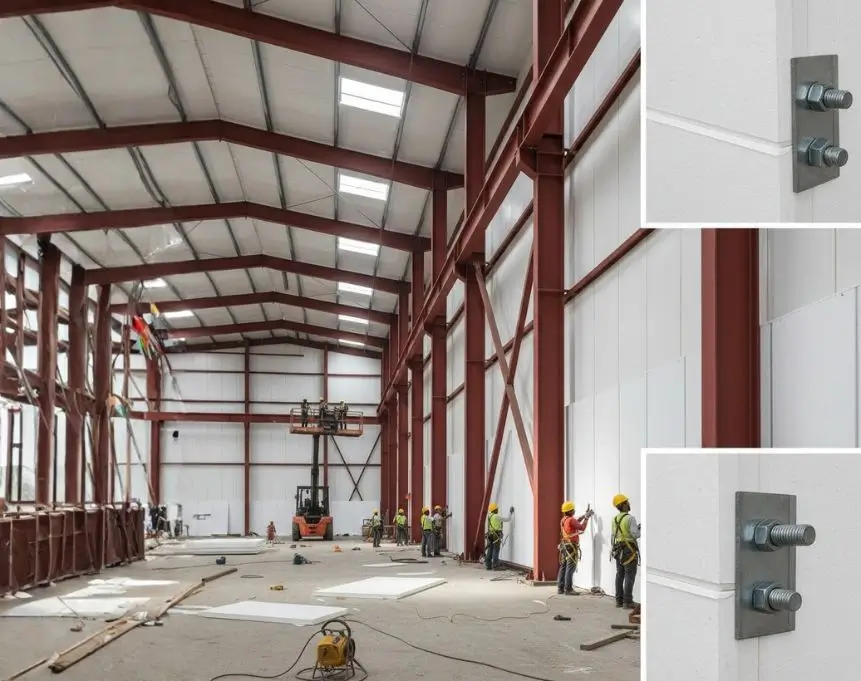
Traditional brick-and-mortar structures struggle under this thermal stress. They have "thermal bridges"—pathways where heat leaks in through concrete joints and beams. Cold storage PEB India solutions solve this through a system of "thermal breaks." In a Metal Tree PEB cold store, the structural steel never touches the external cladding directly without an insulating separator. The entire building envelope acts as a continuous thermos flask. This is not just about keeping the cold in; it is about preventing the moisture out. When warm, humid Indian air meets a cold surface, condensation forms. In a pharma warehouse, that means mold, failed audits, and millions in lost stock. PEB systems allow for the integration of unbroken vapor barriers that effectively seal the building from humidity, a feat nearly impossible with conventional masonry.
Insulation: The First Line of Defense
The heart of cold storage warehouse construction lies in its skin. Standard warehouses might use single-skin metal sheets or minimal insulation. For cold storage, this is insufficient. We rely on high-grade Insulated Sandwich Panels, typically using Polyurethane Foam (PUF) or Polyisocyanurate (PIR) as the core.
- Thickness Matters: For a standard chiller room (0°C to +4°C), a panel thickness of 60mm to 80mm is often adequate. However, for deep freeze applications (-18°C to -25°C), such as those required for frozen meats or ice cream, the industry standard shifts to 100mm to 150mm PUF panels. The density of this foam is critical; we typically spec 40 kg/m³, which provides the structural rigidity to span large heights without buckling while offering maximum thermal resistance (R-value).
- The Cam-Lock Advantage: Metal Tree utilizes panels with cam-lock mechanisms or tongue-and-groove joints. These are not just screwed together; they interlock to create an airtight seal. This prevents "thermal leaking" at the joints, which is the number one cause of energy inefficiency in older facilities.
- Vapor Barriers: Water vapor is a gas that wants to equalize pressure. It will push from the warm, humid outside into your dry, cold interior. If it gets into your insulation, it freezes, destroying the panel’s thermal value. Our designs incorporate high-performance vapor barriers—often a 300-micron polymeric film or specialized foil facings on the panels themselves—to ensure the insulation remains dry and effective for decades.
Designing for Performance: Docks, Floors, and Zoning
A cold storage warehouse is a dynamic machine, not a static box. Forklifts move, doors open, and products cycle through. Your design must accommodate this movement without compromising the thermal envelope.
The Achilles Heel: Loading Dock Design
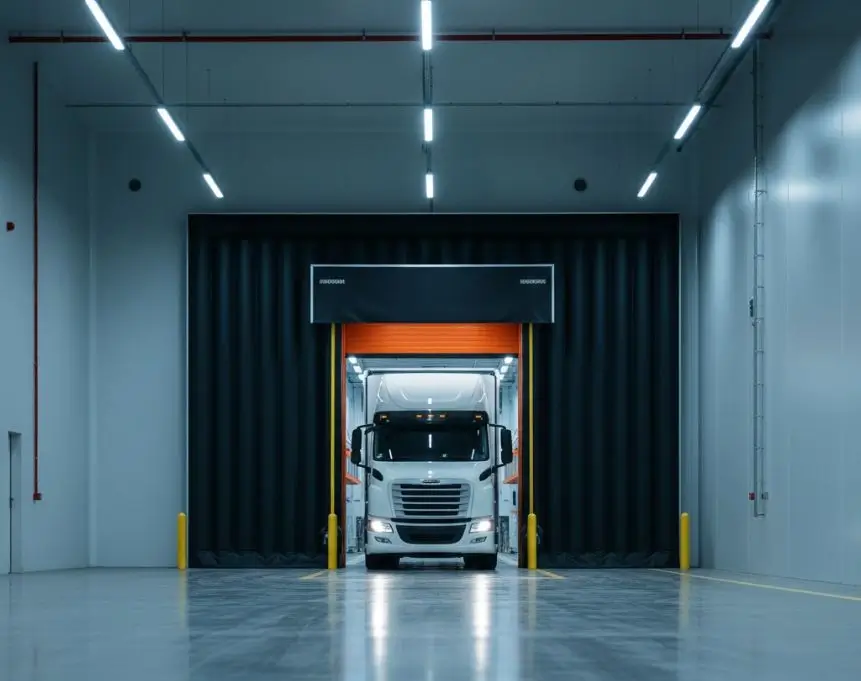
The loading dock is where your cold chain is most vulnerable. Every time a truck backs up, you risk exchanging massive amounts of expensive cold air for hot, dirty ambient air. In temperature-controlled warehouse builders' circles, this is known as "infiltration load."
To combat this, we implement a "sealed dock" system.
- Dock Shelters and Seals: These cushion the rear of the truck, creating a gasket-like seal against the building before the doors even open.
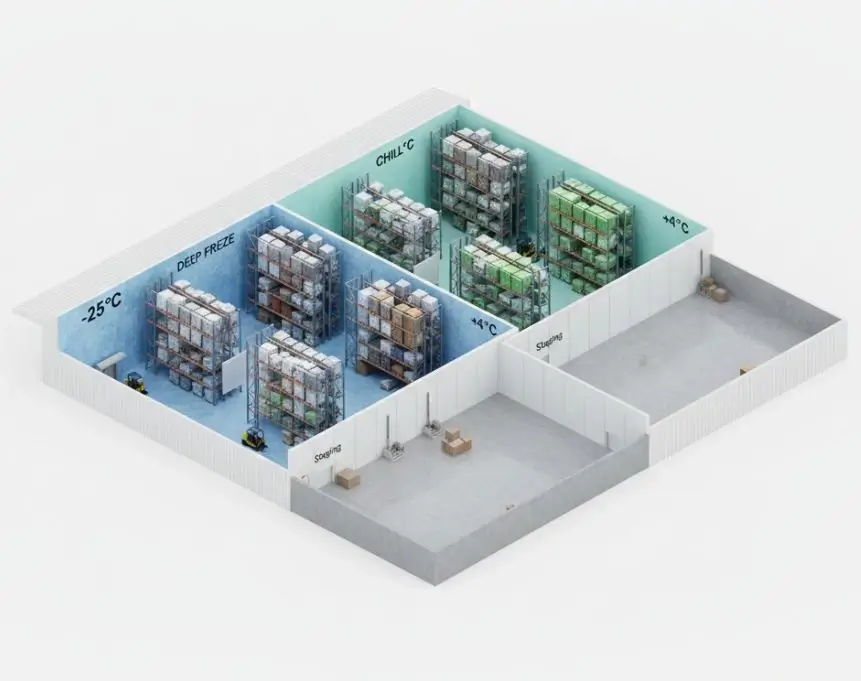
- Vestibules and Airlocks: We often design a "staging area" or ante-room kept at an intermediate temperature (+10°C to +15°C). This acts as a thermal buffer zone.
- High-Speed Doors: Waiting for a slow rolling shutter to close is burning money. We integrate automated high-speed vinyl doors that snap shut in seconds after a forklift passes, minimizing air exchange.
The Foundation: Not Just Concrete
You cannot simply pour a standard concrete slab for a cold storage freezer. The ground beneath a freezer will eventually freeze, causing the moisture in the soil to expand and heave the floor upwards-a disaster known as "frost heave" that can crack the entire building foundation.
Our cold room construction process involves a specialized floor system:
- Sub-base Preparation: Compacted soil.
- Heating System: A network of electric heater mats or glycol pipes is laid to keep the sub-soil just above freezing.
- Insulation: High-density extruded polystyrene (XPS) boards are placed under the slab.
- Vapor Barrier: Heavy-duty sheet to stop ground moisture.
- Concrete Slab: High-strength, reinforced concrete capable of supporting heavy racking loads at low temperatures without shrinking or cracking.
Intelligent Zoning
Modern logistics is rarely about one single temperature. A 3PL (Third Party Logistics) provider might need -25°C for frozen peas, +2°C for milk, and +15°C for chocolate, all under one roof. Pharmaceutical warehouse PEB construction is even more complex, requiring specific zones for vaccines vs. syrups.
PEB flexibility allows us to create "box-in-a-box" designs. The main external shell provides the primary weather protection, while internal partition walls made of insulated sandwich panels divide the space into distinct thermal zones. These internal walls can be moved or reconfigured if your business model pivots from frozen food to pharma, offering a future-proof asset.
Navigating Compliance: FSSAI and Beyond
In India, building a cold storage facility is not just an engineering challenge; it is a regulatory one. The Food Safety and Standards Authority of India (FSSAI) has stringent guidelines for infrastructure.
- Hygienic Design: FSSAI mandates that surfaces must be non-absorbent, non-toxic, and easy to clean. Our pre-painted galvanized iron (PPGI) or stainless steel (SS) panel finishes are smooth, resistant to fungal growth, and can be washed down without degrading.
- Temperature Monitoring: Compliance requires continuous data logging. Metal Tree structures are designed with integrated chases and supports for sensors and cabling, ensuring that your Building Management System (BMS) has total visibility without compromising the airtight seal.
- Pest Control: Gaps are the enemy. The precision engineering of PEB components eliminates the cracks and crevices where pests typically nest, addressing a major compliance hurdle for food and pharma clients.
The Cost Equation: Premium vs. Standard
Let’s address the investment. Business owners often ask, "Why does this cost more than a standard godown?"
The reality is that cold storage warehouse construction commands a premium because you are paying for two distinct systems: the structural shell and the thermal envelope/refrigeration.
- Standard PEB Warehouse: Typically costs between ₹1,200 to ₹1,500 per sq. ft. This gets you a roof, walls, and a floor.
- Cold Storage PEB Warehouse: Costs range from ₹2,000 to ₹3,500+ per sq. ft..
Where Does the Extra 60-90% Go?
- Insulation (30-40%): Those 150mm PUF panels are significantly more expensive than simple corrugated steel sheets. They are complex composite materials.
- Refrigeration (30-40%): The compressors, condensers, evaporators, and piping (Ammonia or Freon based) are a massive capital cost not present in dry storage.
- Specialized Flooring (10-15%): Under-floor insulation and heating add to the civil costs.
- Electromechanicals (10%): specialized lighting that doesn't add heat (LED), automated doors, and backup generators.
While the upfront cost is higher, the "cost of ownership" tells a different story.
ROI: The Energy Efficiency Payback
The operational cost of a cold storage facility is dominated by electricity—often 60-70% of the OpEx. A "cheaper" building with poor insulation (e.g., 60mm panels instead of 100mm) or thermal bridges will force your refrigeration plant to work 30% harder.
- The Math of Insulation: Upgrading from standard insulation to a high-performance Metal Tree envelope can reduce energy consumption by 20-30%.
- Payback Period: In a typical Indian industrial setup, the extra capital spent on superior insulation (80-150mm PUF) and air-tight construction pays for itself in energy savings within 3 to 4 years. After that, those savings go straight to your bottom line for the remaining 20-30 year life of the building.
- Product Safety ROI: Consider the cost of one spoiled batch of insulin or seafood. A single thermal failure can cost more than the entire insulation budget. A robust PEB design is an insurance policy against spoilage.
Why Metal Tree?
At Metal Tree, we don't just sell steel; we sell thermal integrity. We understand that cold storage warehouse construction is a high-stakes game where details matter. From the density of our PUF foam to the seal on our dock levelers, every component is selected to maximize efficiency and minimize risk. We are temperature-controlled warehouse builders who speak the language of FSSAI, heat load, and ROI.
Whether you are storing apples, antibiotics, or ice cream, your product deserves a home that protects its value. A Metal Tree PEB cold storage facility is that home—built fast, built to last, and built to save you money every single day it operates.
Frequently Asked Questions (FAQ)
For standard chiller rooms (0°C to 5°C), 60mm to 80mm PUF panels are recommended. For frozen storage (-18°C to -25°C), you should use 100mm to 150mm thickness to ensure thermal efficiency and prevent compressor overload.
The cost typically ranges from ₹2,000 to ₹3,500 per sq. ft., depending on the temperature requirements, refrigeration technology, and size. This is generally 60-90% higher than a standard dry warehouse due to the specialized insulation and machinery involved.
Yes, if you are storing food products. FSSAI guidelines mandate specific hygiene standards, lighting, and temperature control infrastructure. PEB structures with smooth, cleanable PUF panels are ideal for meeting these strict regulatory requirements.
Absolutely. One of the biggest advantages of cold storage PEB India solutions is modularity. We can easily expand the length of the building or add new insulated partition walls to create additional temperature zones as your business grows.
With high-quality thermal break design and proper air sealing, PEB cold storage facilities can reduce energy consumption by 20-30% compared to poorly insulated traditional masonry structures, leading to a rapid ROI.