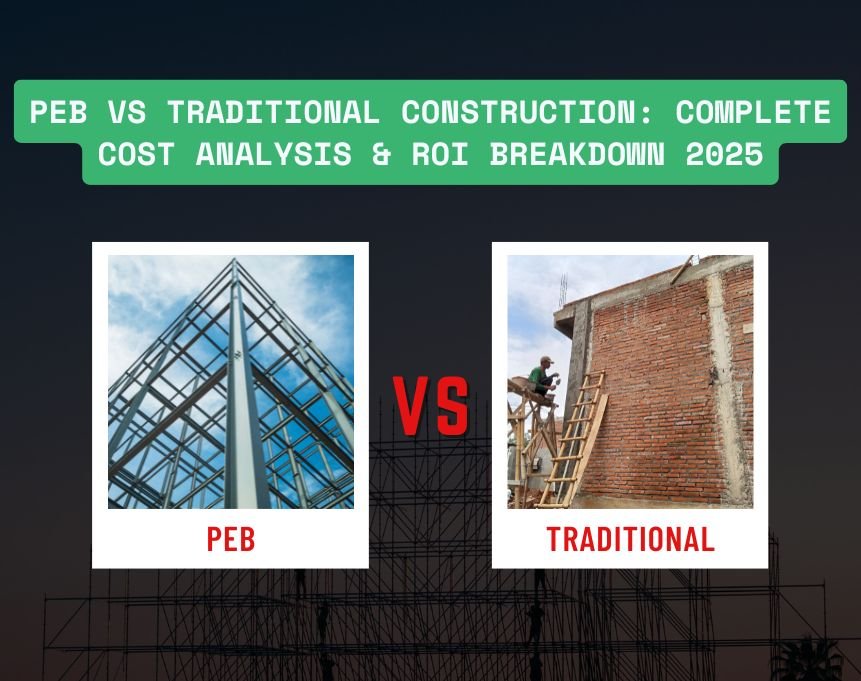
Main Takeaway: Pre-Engineered Buildings (PEBs) deliver up to 40% cost savings and faster returns on investment compared to traditional construction, making them an optimal choice for Indian businesses in 2025.
Introduction
Imagine a manufacturing company racing against tight deadlines and runaway construction costs. Traditional construction projects often encounter delays, budget overruns and complex approvals, leaving business owners frustrated and cash-strapped. Enter pre-engineered buildings (PEB) – a flexible, speedy and cost-effective alternative that has revolutionized the construction landscape in India. In this blog, we dive deep into the cost comparison and ROI breakdown of PEB vs traditional construction, equipping business owners—from logistics firms to agro-based enterprises—with the insights needed to make informed decisions in 2025.
Why Pre-Engineered Buildings Are Gaining Ground in India
The Changing Face of Construction
Over the past decade, India’s infrastructure demands have skyrocketed. From warehousing boom to burgeoning data centers, businesses require scalable, durable structures built on tight schedules. Traditional brick-and-mortar methods, while reliable, struggle to keep pace with evolving needs.
Key Advantages of PEB in the Indian Context
- Speed of Construction
PEB projects typically complete 30–50% faster than traditional builds. Metal Tree’s streamlined manufacturing and on-site assembly approach ensures roofs, frames and cladding arrive ready to install, reducing labor time on site. - Cost Predictability
Fixed engineering costs and standardized components lead to tighter budgets. Unlike on-site fabrication, PEB minimizes material wastage and change orders, curbing unforeseen expenses. - Design Flexibility
Customizable spans up to 100 meters without internal columns offer uninterrupted floor space-ideal for large-format warehouses or manufacturing halls. - Durability and Maintenance
Galvanized steel members resist corrosion, lowering maintenance outlays over a 30–50-year lifespan.
Detailed Cost Breakdown: PEB vs Traditional Construction
Below is an estimated cost comparison for a 10,000 sq. m. industrial shed in India (Mumbai region) in 2025:
| Cost Component | PEB Approx (Rs/sq. m.) | Traditional Approx (Rs/sq. m.) | Notes |
| Civil Works (Foundations, Flooring) | 1,200 | 1,500 | PEB: Shallow strip foundations. Traditional: Deeper footings, higher formwork costs.house0+ |
| Structural Frame | 850 | 1100 | PEB: Factory-fabricated steel sections. Traditional: On-site fabricated RCC or steel with higher labor charges. |
| Roof and Cladding | 650 | 900 | Prefinished insulated panels vs corrugated sheets and insulation installed on-site. |
| Doors, Windows, Accessories | 300 | 400 | Standard PEB accessories kit vs custom joinery in traditional models. |
| Erection and Installation | 500 | 700 | PEB: Mechanized crane-based installation. Traditional: Higher manual labor and longer timelines. |
| Finishing and Painting | 250 | 350 | Protective coatings in a controlled environment for PEB. Traditional requires rework due to weather delays. |
| Project Management and Overheads (10%) | 375 | 495 | Based on subtotal. |
| Total Estimated Cost | 4,125 | 5,445 | PEB yields ~24% cost saving |
Note: Prices exclude land, utilities, site preparation, and complex interiors. Always seek detailed quotes for your project specs.
Lifecycle Cost Analysis
When assessing total cost of ownership over 20 years, PEB and traditional structures diverge further:
| Cost Element | PEB Approx (Rs per sq. m.) | Traditional Approx (Rs per sq. m.) |
| Initial Construction Cost | 4,125 | 5,445 |
| Annual Maintenance (avg.) | 35 | 50 |
| Repair & Refurbishment | 20-year cycle: ₹200 | 20-year cycle: ₹350 |
| 20-Year Lifecycle Total | 5,025 | 6,945 |
Over two decades, a PEB building costs roughly ₹1,920 per sq. m. less than its traditional counterpart—a 28% lifecycle saving.
ROI Breakdown: How Quickly Do You Recoup Your Investment?
To evaluate return on investment, consider:
- Rental Income: A logistics firm leasing a 5,000 sq. m. PEB warehouse at ₹150 per sq. m. per month earns ₹9 lakh monthly.
- Cost Recovery Period:
- PEB: Investment of ₹2.06 crore (5,000 × ₹4,125)
– Monthly cash inflow: ₹9 lakh
– Payback: 23 months - Traditional: Investment of ₹2.72 crore (5,000 × ₹5,445)
– Payback: 30 months
- PEB: Investment of ₹2.06 crore (5,000 × ₹4,125)
Thus, choosing PEB shortens payback by 7 months, accelerating cash flow and freeing capital for growth initiatives.
Factors Influencing Cost and ROI
- Location and Site Conditions: High ground water or poor soil may require deeper foundations, reducing PEB’s cost edge.
- Design Complexity: Unique architectural features or multi-story layouts can narrow the cost differential.
- Material Price Volatility: Fluctuations in steel and cement markets impact both methods; PEB firms often hedge by bulk procurement.
- Labor Rates and Availability: In regions with expensive skilled labor, PEB’s mechanized installation yields greater savings.
Why Metal Tree Is Your Trusted PEB Partner
Metal Tree brings:
- Expertise: Over two decades in pre-engineered building design and execution.
- End-to-End Service: From structural analysis to turnkey installation.
- Custom Solutions: Tailored PEB kits for warehouses, factories, commercial spaces and more.
- After-Sales Support: Preventive maintenance plans and rapid response teams.
Conclusion
In 2025’s dynamic market, PEBs offer Indian businesses a compelling value proposition: reduced costs, accelerated timelines and enduring performance. Whether you’re a manufacturing company scaling up or a logistics firm optimizing inventory flow, Metal Tree’s pre-engineered building solutions ensure you build smarter, faster and more sustainably.
Embrace PEB and secure your ROI sooner- because in today’s competitive landscape, time truly is money.
Addressing Common Concerns
Q1: Are PEBs Less Durable Than Traditional Structures?”
A: No. PEB frames use high-tensile galvanized steel, designed to withstand seismic zones and heavy loads. Protective coatings and periodic inspections ensure longevity on par—or superior—to traditional builds.
Q2: Can I Customize the PEBs Aesthetics?”
A: Absolutely. PEB systems offer a wide palette of color-coated panels, façade cladding options and architectural accents to meet brand identity or local zoning aesthetics.
Q3: What About PEBs Regulatory Approvals?”
A: Metal Tree’s in-house engineering team handles all structural calculations and liaises with local authorities, expediting clearances to keep your project on schedule.
Q4: PEBsRhetorical Reflection
A: Why settle for bricks and mortar when the future of construction is built in a factory? Pre-engineered buildings marry precision engineering with rapid delivery—prompting the question: Why should your next project wait?
Follow us on: