The Indian construction industry is currently navigating a profound structural renaissance. As a pivotal contributor to the national GDP and the second-largest employer in the country, the sector has long been defined by Reinforced Cement Concrete (RCC). However, this traditional methodology often suffers from protracted timelines, significant material wastage, and a substantial environmental toll. Today, the landscape is shifting toward more sophisticated, technology-driven solutions, with Pre-Engineered Building (PEB) systems at the epicenter of this transformation.
In a nation committed to achieving Net Zero emissions by 2070, the construction sector—which accounts for approximately 24% of India’s annual carbon emissions—must adopt radical decarbonization strategies. PEB technology addresses this imperative by offering a structural concept that is not merely a faster alternative to traditional methods but a cornerstone of sustainable development.
The Engineering Paradigm: Precision Over Redundancy
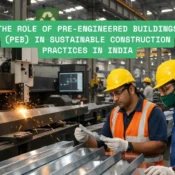
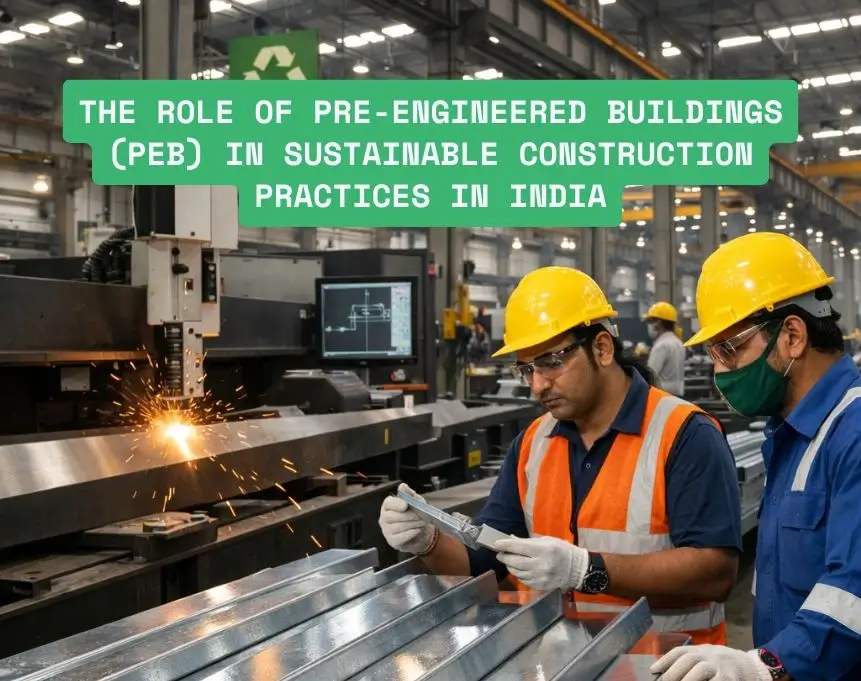
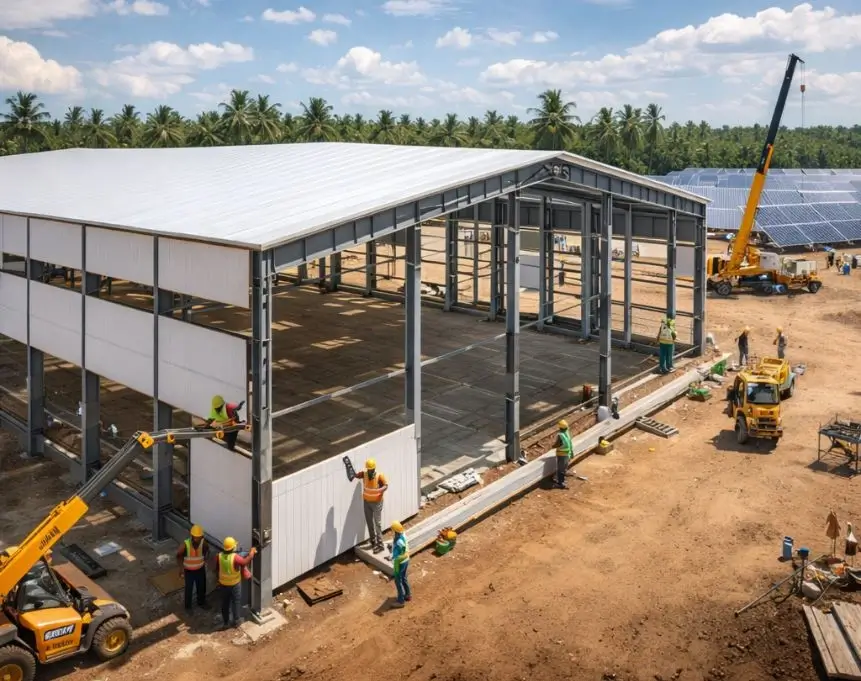
A Pre-Engineered Building is a structure designed, engineered, and fabricated in controlled factory environments before being transported for rapid on-site assembly. This industrialized approach allows for a level of precision and resource efficiency that traditional in-situ methods cannot replicate.
1. Structural Anatomy and Optimization
The engineering of a PEB is a sophisticated integration of structural design and manufacturing logic. Unlike conventional buildings where components are often oversized to account for on-site variations, PEBs are designed with surgical precision.
- Primary Framing: The skeletal backbone, comprising columns and rafters, often uses tapered sections. Steel depth is increased at points of maximum bending moment and reduced where stresses are lower, ensuring the structure uses the minimum amount of steel necessary.
- Secondary Elements: Purlins, girts, and eave struts provide lateral stability and support for cladding. These are typically cold-formed from galvanized steel, providing a high strength-to-weight ratio.
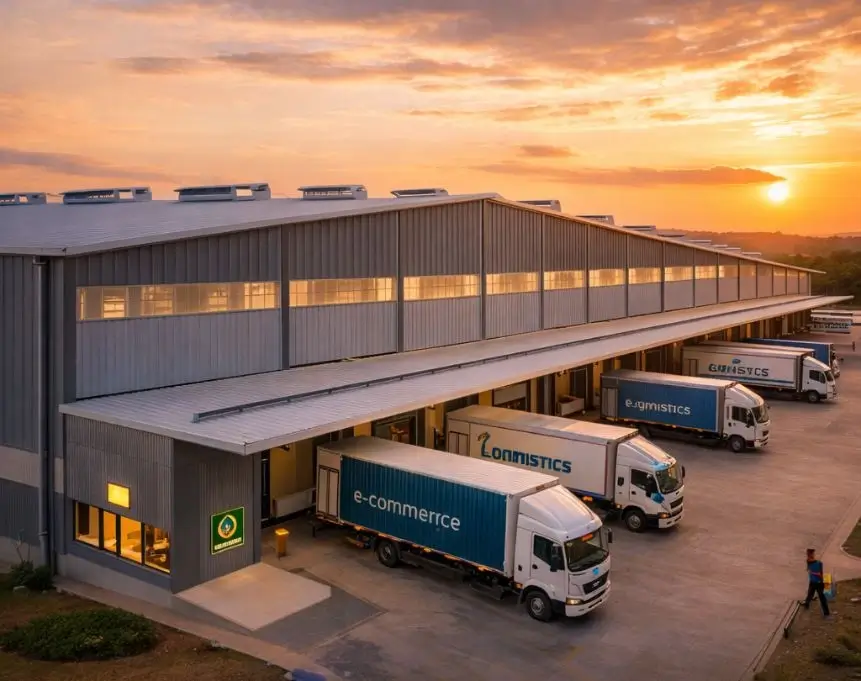
- Clear Spans: This unified system allows for massive clear spans of up to 90 or 100 meters without internal support columns. This unobstructed space is critical for modern logistics, enabling higher storage density and smoother operational flow.
2. Material Efficiency and Waste Reduction
Embodied carbon represents the emissions associated with manufacturing, transportation, and assembly. In India, reducing the volume of steel used is the most effective way to lower this footprint. PEB fabrication plants use Computer-Aided Design (CAD) to determine exact member sizes, preventing the over-ordering of materials. This results in a 20% to 30% reduction in steel usage compared to conventional steel buildings. Furthermore, material waste in a controlled factory environment is reduced by up to 50%, with any off-cuts being immediately recycled.
Sustainability as a Core Metric: The Environmental Lifecycle
PEB technology can reduce the total carbon footprint of a structure by up to 40%. This reduction is multifaceted, involving every stage of the building's lifecycle.
1. Operational Energy and Thermal Management
In India’s tropical climate, heat mitigation is the primary operational challenge. PEB systems address this through advanced building envelopes:
- Insulated Sandwich Panels: These consist of an insulating core (like Polyurethane Foam - PUF, or Rockwool) sandwiched between metal skins. PUF panels are the industry standard for cold storage due to their airtightness and thermal resistance.
- Cool Roof Technology: Highly reflective coatings on roofing sheets can reduce heat gain by up to 40%.
- HVAC Savings: A case study of a manufacturing warehouse near Pune showed that insulated panels led to a 22% decrease in annual HVAC energy consumption.
2. Water Conservation: The "Dry" Process
Water scarcity is a growing crisis in India. Conventional RCC construction is exceptionally "thirsty," requiring vast quantities of water for mixing, aggregate washing, and curing. In contrast, PEB construction is a "dry" process. Components are bolted together on-site, requiring minimal water only for the foundation.
3. Site Preservation and Circularity
Steel is one of the most recycled materials globally; nearly 95% of steel products can be recycled without losing their engineering properties. At the end of a PEB’s service life, the modular framework is fully reclaimable, reducing demolition waste that would otherwise end up in landfills. Additionally, the 60% faster assembly speed reduces the duration of on-site activity, minimizing soil erosion and dust pollution in surrounding communities.
Economic and Logistical Efficiency
The competition between PEB and RCC is also a choice of building philosophies. PEB offers superior lifecycle value and financial advantages.
- Construction Timelines: In a typical project, factory fabrication occurs simultaneously with on-site foundation work. This concurrency allows a project that would take 12 months in RCC to be completed in just 5 to 7 months.
- Opportunity Costs: For e-commerce and logistics sectors, this time saving translates directly into a faster Return on Investment (ROI). For a 300,000 sq. ft. warehouse, the net financial advantage of choosing PEB over RCC can be as high as ₹35 Crores when accounting for early occupancy revenue.
Maintenance: High-quality factory-applied coatings resist corrosion, resulting in significantly lower maintenance requirements compared to traditional structures.
Navigating Green Building Frameworks: IGBC, GRIHA, and EDGE
In India, building sustainability is codified through rating systems like the Indian Green Building Council (IGBC) and GRIHA. PEBs are exceptionally well-positioned to achieve high scores under these frameworks.
1. Credit Mapping for PEB PEB technology earns points in several critical areas:
- Materials and Resources: High recycled content and minimal waste during fabrication.
- Energy Efficiency: High-performance cladding and solar-ready roofing.
- Indoor Environmental Quality: Superior daylighting via translucent panels and better ventilation through ridge vents.
2. State-Level Incentives and Policy Drivers The Indian government incentivizes green construction, often tying rewards to IGBC or GRIHA ratings.
- Additional FAR/BAR: States like Haryana (9%-15%), Punjab (5%-10%), Uttar Pradesh (10%), and Rajasthan (0.075-0.15) offer additional Floor Area Ratio for certified green buildings.
Financial Subsidies:Andhra Pradesh offers a 25% subsidy on total fixed capital investment for industrial buildings with an IGBC green rating. Tamil Nadu provides a similar 25% subsidy on environmental protection infrastructure costs.
Case Studies: Realizing Sustainable Infrastructure
The benefits of PEB are validated through diverse real-world applications across India.
- Marino Foods, Telangana: To meet market demand quickly, a 100,000 sq. ft. facility was designed with a full mezzanine floor using food-grade materials. The project was delivered ahead of schedule, allowing operations to start without downtime.
- Hyderabad Fulfillment Center (IGBC Gold): A 300,000 sq. ft. automated center for a leading e-commerce giant integrated cool roof technology and achieved a 40% reduction in construction time, saving ₹8 Crores in initial capital outlay.
Shristi Warehouse, New Delhi (EDGE Certified): This project achieved 30% energy savings, 54% water savings, and 53% less embodied energy in materials. The use of aluminum-clad sandwich panels and smart meters enabled these results.
Technological Frontiers: The Digital Transition
The next phase of PEB sustainability is driven by digital integration, moving from "Pre-Engineered" to "Digital-Engineered".
- Building Information Modeling (BIM): BIM creates a virtual twin of the building, identifying clashes between steel and utilities before manufacturing. This reduces on-site rework—a major source of carbon emissions.
- IoT and Digital Twins: Sensors can monitor real-time energy consumption and structural health. Digital twins are used for predictive maintenance, addressing issues like paint degradation before they require energy-intensive repairs.
Industry 4.0: The column-free spaces of PEBs are ideal for Automated Storage and Retrieval Systems (ASRS) and robots, which require high vertical clearances and precise floor leveling.
Conclusion: Metal Tree and the Future of Construction
Pre-Engineered Buildings represent a paradigm shift for sustainable construction in India. By industrializing the construction process, PEBs have decoupled industrial growth from environmental degradation. They offer a trifecta of benefits: economic (faster ROI), environmental (40% lower carbon footprint), and social (improved safety and comfort).
At Metal Tree, we recognize that sustainable construction is no longer a luxury—it is an economic and regulatory necessity. Our expertise in PEB fabrication and green building solutions aligns with India's roadmap toward a Net Zero future. By embracing precision engineering, advanced materials, and digital integration, we are not just building structures; we are building the foundation of a resilient, efficient, and greener India. Embrace sustainable steel buildings today and build a better tomorrow with Metal Tree.