Across India, manufacturing units, logistics parks, hospitals, schools, and infrastructure projects are under pressure to go live sooner, control costs, and meet stricter sustainability norms. Delays from labour shortages, unpredictable weather, and site restrictions often push traditional RCC projects off schedule and over budget.
In this environment, off-site factory-made building systems-whether in the form of steel modules, prefabricated cabins, or light-gauge steel framing-are becoming a practical alternative. They allow construction and site work to run in parallel, cut waste, and offer much better predictability than site-built methods. For Indian businesses that cannot afford year-long construction cycles or severe disruption to ongoing operations, this shift is especially relevant.
Snapshot: 10 Key Modular Construction Advantages
- Faster overall project completion
- Lower and more predictable project costs
- Stronger sustainability performance and lower waste
- Consistent quality control in factory conditions
- Safer, more organised construction environment
- High design flexibility and easy expansion
- Minimal disruption to running operations
- More predictable timelines and reduced risk
- Reusable and relocatable building assets
- Strong fit with PEB, LGFS, and prefab systems used by companies like Metal Tree in India
What Is Modular Construction?
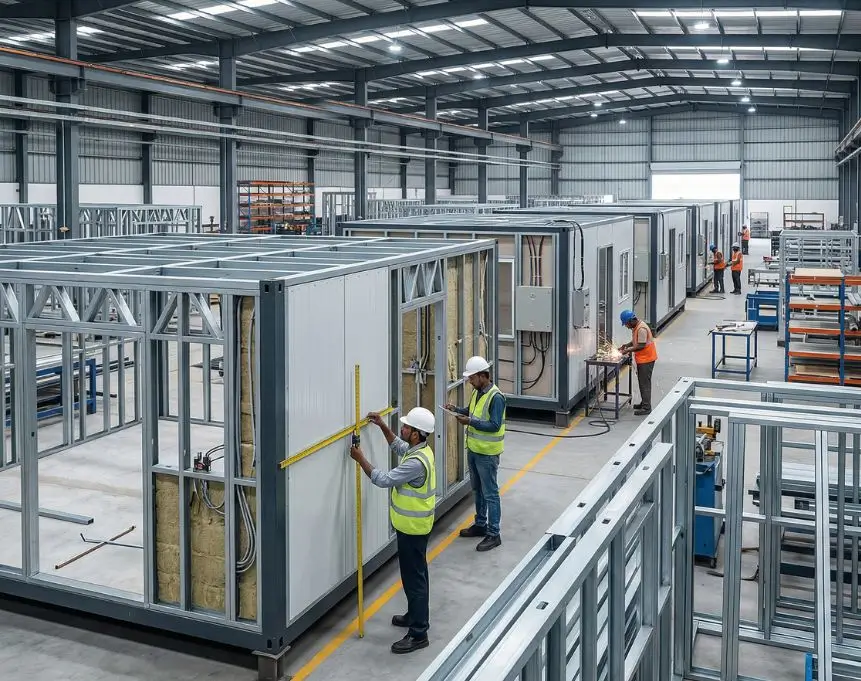
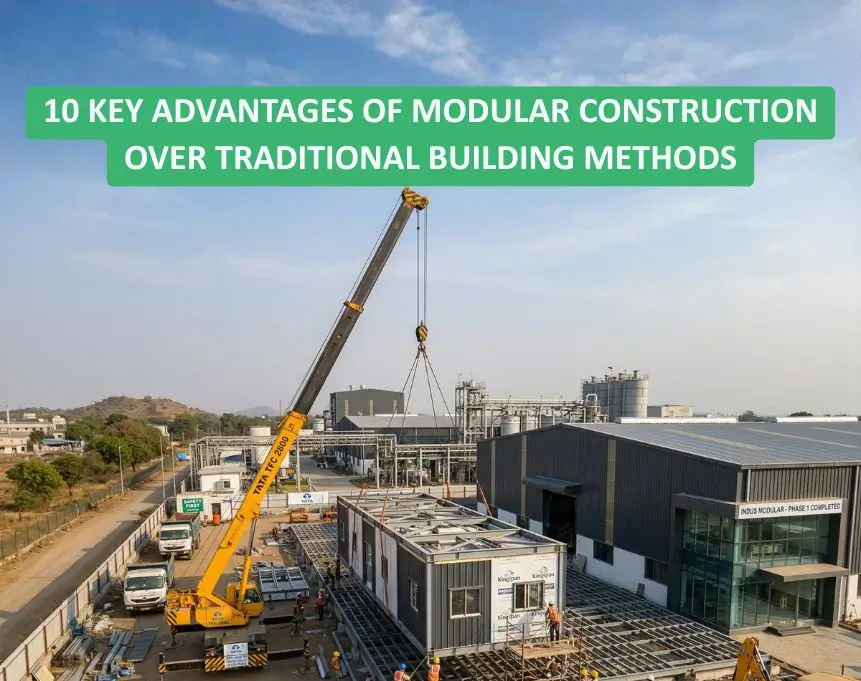
Modular construction is a method where major building components or “modules” are manufactured in a factory and then transported to the site for final assembly. Each module is produced with plumbing, electricals, internal finishes, and insulation already integrated, so the on-site phase mainly involves installation and connection.
Because most of the work happens in a controlled environment, modular projects are less exposed to weather, local labour shortages, and site access issues. In India, modular systems often combine pre-engineered steel structures, light-gauge steel framing (LGFS), and insulated sandwich panels-exactly the technologies companies like Metal Tree specialise in for fast, precise and energy-efficient buildings.
Modular approaches can be used for a wide range of applications: portacabins, worker housing, institutional buildings, warehouses, factory buildings, multistorey commercial spaces, and even emergency or temporary infrastructure. This flexibility makes them a strong alternative to purely site-built RCC, especially where speed and standardisation matter.
Top 10 Benefits
1. Faster Construction
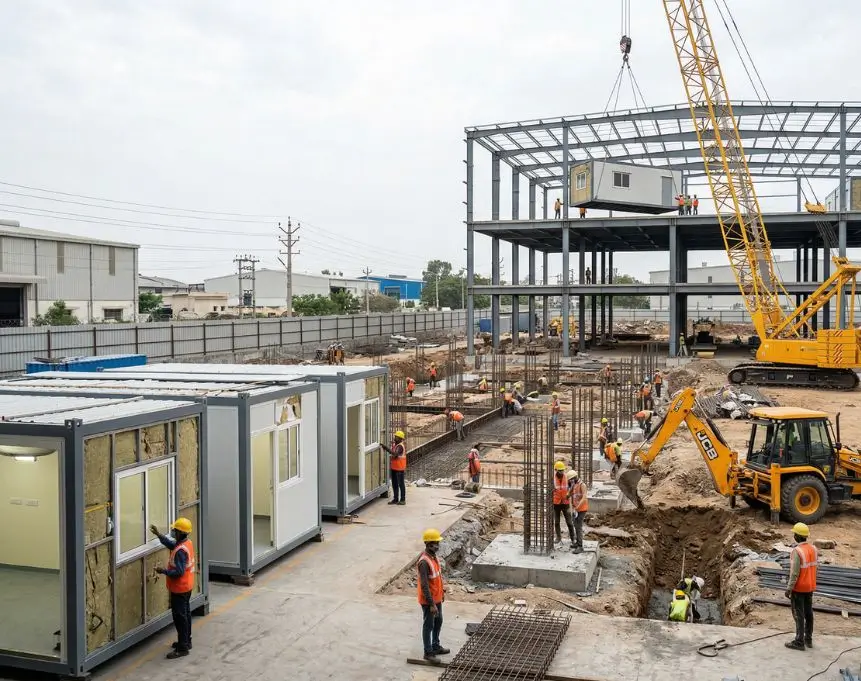
Multiple global studies show that modular construction can reduce overall project timelines by about 25–50% compared to traditional methods. While the foundation and site preparation happen on-site, the modules are manufactured in parallel at the factory-so you compress the schedule instead of waiting for each phase to finish.
Key speed drivers:
- Parallel activities: Site work and module production run together instead of in sequence.
- No weather stoppages in the factory: Rain or extreme heat affect the site far less.
- Pre-fitted interiors: Flooring, partitions, and services are already inside the module, so fit-out time on-site collapses.
For a fast-growing Indian manufacturer or logistics operator, shaving months off commissioning can mean earlier production, quicker revenue, and a real competitive advantage.
2. Cost Savings and Budget Control
Even if the upfront module cost looks similar to or slightly higher than conventional work, the total project cost often comes down once you account for time, labour, and waste.
How modular helps manage budgets:
- Lower labour intensity on-site, as most work is done in the factory with smaller, specialised teams.
- Less rework and material wastage due to precision manufacturing and repeatable processes.
- Fewer delays from weather or coordination issues, which translates into fewer cost overruns and claims.
Prefab modular buildings have also been shown to dramatically cut material waste-some reports estimate reductions of up to 80%, translating into direct savings on materials and disposal. For Indian businesses operating on thin margins, that combination of time and cost control is extremely powerful.
3. Sustainability and Lower Environmental Impact
Sustainability is no longer just a CSR talking point; it is increasingly linked to regulatory compliance, investor expectations, and energy costs. Modular construction supports these goals in several ways.
Environmental advantages include:
- Efficient material usage and bulk recycling inside the factory, leading to significantly less onsite waste and up to 30–40% lower emissions in some prefab studies.
- Lower site disturbance, with fewer truck movements, less noise, and shorter construction windows around sensitive urban or institutional zones.
- Better integration of high-performance insulation, airtightness, and energy-efficient design-common in insulated sandwich panel and LGFS systems.
For projects like warehouses, factories, and institutional buildings where energy bills are a long-term operating cost, these gains translate into tangible lifetime savings.
4. Superior Quality Control
Traditional sites rely heavily on supervision, varying skill levels, and changing conditions. Modular construction, by contrast, benefits from repeatable factory processes and strict checks at each stage.
Why quality tends to be higher:
- Controlled environment: No rain, dust, or site clutter affecting curing, finishes, or fitment.
- Standardised processes and jigs that minimise dimensional errors and misalignment.
- Each module inspected before shipping, including structural, electrical, and plumbing checks.
Light Gauge Steel Framing, commonly used in modular projects, is produced to tight tolerances in the factory, ensuring accurate dimensions and better alignment than typical site-cut members. For Metal Tree–style solutions, this means every panel and frame consistently meets design intent, improving building performance and reducing callbacks.
5. Safer Construction Environment
Construction sites are inherently risky-working at heights, heavy lifting, weather exposure, and congestion create accident potential. By shifting a large share of the work to factories, modular construction cuts these risks significantly.
Safety benefits include:
- Fewer workers and less heavy equipment on-site, which reduces typical site hazards.
- Indoor production that shields workers from extreme temperatures, rain, and dust, improving productivity and safety.
- Shorter site duration, meaning reduced exposure to risks for both workers and nearby communities.
For Indian industrial areas with constrained access or live operations, safer, shorter onsite activity can be a major plus during audits and compliance checks.
6. Design Flexibility and Scalability
Modular does not mean “cookie cutter.” Modern systems, especially those based on steel and LGFS, allow considerable design freedom and future expansion options.
Flexibility shows up in multiple ways:
- Customised layouts that integrate production lines, mezzanines, canopies, and service cores.
- Easy additions-extra modules can be attached later when you expand capacity.
- Compatibility with different façade treatments (ACP, glass, sheets, cladding) to match brand or local norms.
For a growing Indian enterprise, this modularity means the building can evolve with your business instead of locking you into a single phase design.
7. Minimal Disruption to Ongoing Operations
Traditional construction next to an active plant, hospital, or school often causes dust, noise, traffic, and safety concerns. Because modular solutions require fewer onsite activities and shorter assembly periods, the disturbance is much lower.
Typical gains include:
- Cleaner, quieter sites with less cutting, welding, and mixing happening on the ground.
- Short “installation windows” where modules are craned into place, often scheduled during off-peak hours or weekends.
- Reduced need for material storage, worker facilities, and laydown areas, which is crucial on tight urban plots.
This is especially valuable in Indian metros where space is limited and neighbours are close, or in brownfield industrial expansions where the main plant must keep running.
8. Predictable Timelines and Lower Risk
Because so much of the process is pre-planned and executed in a factory, modular construction offers more predictable schedules and fewer nasty surprises.
Risk reduction comes from:
- Fixed manufacturing slots and repeatable workflows that make slippages less likely.
- Less weather dependency, cutting the probability of monsoon-related delays.
- Reduced chance of design changes midstream, since detailing is frozen earlier and coordinated upfront.
For CFOs and project heads, this predictability makes cash-flow planning and commissioning dates more reliable than in traditional, highly variable site-built projects.
9. Reusability and Relocatability
Many modular units are designed so they can be dismantled, moved, and reassembled with relatively little waste-unlike RCC structures that generally have to be demolished.
Practical implications:
- Temporary worker colonies, site offices, classrooms, or healthcare facilities can be relocated to the next project or expansion site.
- Businesses can monetise or repurpose assets instead of writing off a building entirely if the land use changes.
- Short-term leases, remote locations, or emergency response buildings become much more feasible.
For sectors like infrastructure, mining, and disaster relief, this reusability significantly increases the lifetime value of each building investment.
10. Strong Fit with Modern PEB and LGFS Systems
In India, modular construction dovetails naturally with pre-engineered steel buildings (PEBs), insulated sandwich panels, and LGFS technologies already adopted by leading players like Metal Tree.
When combined, you get:
- Fast, engineered steel frameworks using PEB concepts.
- Lightweight, high-precision walls and floors using LGFS, ideal for multistorey structures.
- Energy-efficient insulated panels for roofs and walls that improve comfort and reduce energy costs.
Because Metal Tree focuses on design excellence in pre-engineered and prefabricated buildings from its base in Greater Noida, it can integrate these systems into modular solutions tailored to Indian industrial, commercial, and institutional needs.
Comparison with Traditional Construction
Modular vs Traditional: Key Differences
Traditional RCC and brick construction still makes sense where on-site customisation, incremental decision-making, or very simple low-rise projects dominate. However, wherever speed, predictability, and lifecycle costs matter, modular construction offers clear advantages, especially when integrated with PEB and LGFS technologies.
Infographic-Style Summary Sections
“At a Glance” – Modular vs Traditional
- Up to 25–50% faster project completion with modular methods.
- Significantly reduced material waste and disposal costs.
- Better energy performance and airtightness with factory-fitted insulation.
- Safer, cleaner sites and less disruption to operations.
- Reusable and relocatable assets for changing business needs.
Ideal Use Cases for Modular Buildings in India
- New warehouses or factory buildings where speed-to-market is critical.
- Institutional and commercial projects that must be built while the campus stays operational.
- Worker housing, portacabins, and emergency buildings for infrastructure and disaster-relief projects.
FAQ: Modular Construction for Indian Businesses
It is especially suitable for warehouses, manufacturing facilities, logistics hubs, schools, hospitals, office blocks, and emergency or temporary buildings that must be delivered quickly and with minimal operational disruption. These are exactly the types of projects where PEB and prefab specialists like Metal Tree already deliver high-performance steel and modular solutions.
Properly engineered modular projects are designed to comply with IS codes, local bylaws, and fire requirements, using rated panels, protected steelwork, and approved materials. Reputed manufacturers and PEB designers build compliance into the design stage so that the finished building meets structural, safety, and occupancy standards just like a conventional RCC structure.
With galvanised steel framing, high-quality coatings, and durable sandwich panels, modular structures can deliver long service life with relatively low maintenance, especially compared to poorly maintained masonry or non-engineered sheds. Components can also be repaired, upgraded, or replaced module by module, extending building life and improving lifecycle economics.
Businesses in Delhi–NCR and beyond can work with specialists like Metal Tree Engineering in Greater Noida, which focuses on pre-engineered buildings, light gauge steel framing, insulated panels, and prefabricated structures. Because such companies handle both design and execution, they can help you evaluate whether modular, hybrid, or traditional construction is best for your specific project.
Modular construction can be cheaper over the full project lifecycle because you save on labour, reduce waste, and finish sooner, which lowers financing and overhead costs. While the initial module price may look comparable to conventional work, the predictable schedule and fewer surprises help prevent budget overruns common with traditional projects.
Depending on project complexity, modular methods can typically reduce total timelines by around 25–50%, largely because off-site manufacturing and on-site work run in parallel. Indoor production also avoids many weather delays, so time estimates tend to be more reliable than in conventional site-built projects.
Modern modular systems use engineered steel, LGFS, and high-quality panels designed to meet structural codes, wind loads, and seismic requirements. Because modules are built to handle lifting and transportation stresses as well, they are often more robust than equivalent traditional partitions or non-engineered structures.
Yes, modular buildings can be tailored in layout, height, façade treatment, and interior specification, especially when combined with PEB and LGFS frameworks. The key difference is that most design decisions must be frozen earlier so the factory can produce precise components, whereas traditional construction allows more midstream changes (often at the cost of time and budget).