In India’s fast-growing cities and industrial hubs, many businesses and families are looking for ways to build faster without getting stuck in year-long construction delays. Prefabricated structures assembled from factory-made components have emerged as a practical option for offices, housing, and support facilities where speed, flexibility, and predictable quality really matter. As infrastructure expands and land costs rise, this approach to building is becoming a natural fit for manufacturing units, logistics parks, educational institutions, developers, and even farmhouse owners across the country.
Affordable prefabricated buildings combine factory precision with on-site speed to deliver strong, thermally efficient structures at a lower lifetime cost than many traditional constructions. Metal Tree, based in Greater Noida, specializes in pre-engineered and prefabricated buildings that are designed, fabricated, and installed as complete solutions across India, helping clients control budgets while achieving modern designs. This guide explains current price ranges, design options, cost-saving tips, and how to choose the best supplier for low cost prefab homes India and budget modular buildings.
Prefabricated Buildings Price Range in India
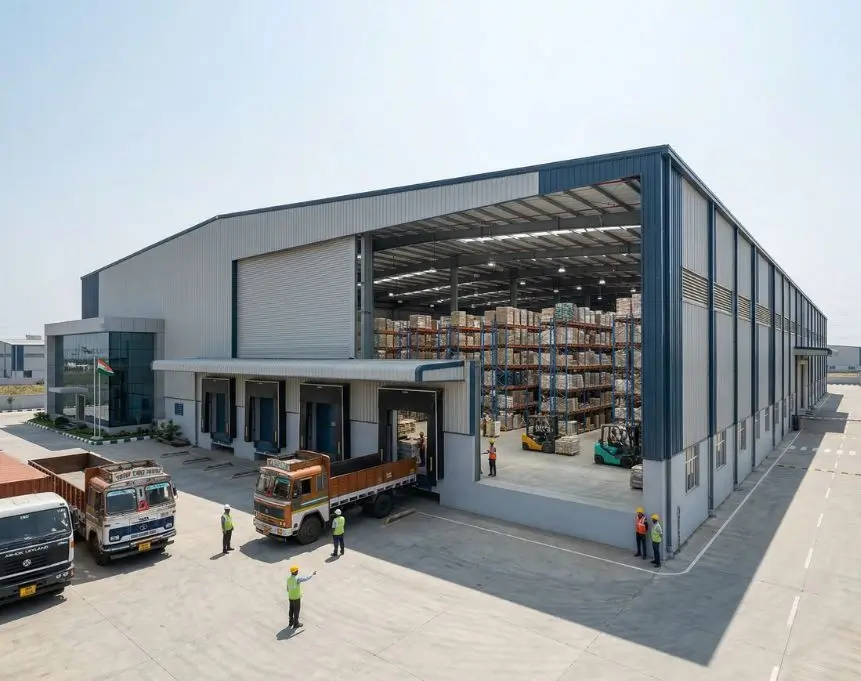
When people search for prefab house cost India, the first number they want to see is the approximate cost per square foot. While exact pricing always depends on specifications, finishes, and location, recent market data and supplier disclosures show clear bands for different quality levels. Compared to conventional brick-and-mortar, prefabricated buildings typically reduce total project cost by about 10 to 25 percent through faster timelines, controlled material use, and lower on-site labour.
Typical prefab price bands (per sq ft)
- Basic prefab homes or cabins: roughly Rs 1,000 to Rs 1,500 per sq ft for simple, functional accommodation with basic finishes and minimal interior fit-out.
- Mid-range prefabricated buildings: around Rs 1,500 to Rs 2,500 per sq ft for better insulation, refined interiors, and more architectural detailing suitable for offices, schools, or mid-segment housing.
- Premium modular villas and designer farmhouses: generally Rs 2,500 to Rs 4,000 per sq ft when you add high-end finishes, large glazing areas, premium bathroom and kitchen fittings, and complex roof forms.
- Industrial PEB sheds and warehouses: structural shells often fall in the range of about Rs 300 to Rs 600 per sq ft for steel frame and cladding, while fully finished industrial buildings with floors, services, and interiors can reach Rs 900 to Rs 1,500 per sq ft.
For many buyers interested in affordable prefabricated buildings, the sweet spot is usually the basic to mid-range band, where smart design and materials deliver solid performance without overspending on luxury finishes. Metal Tree works within these bands to customise specifications according to each client’s budget and performance needs, whether for site offices, worker housing, or institutional buildings.
Example budgets for Indian buyers
Consider a small manufacturing company near Pune that needs 10,000 sq ft of shop floor and 2,000 sq ft of office space. Choosing a pre-engineered steel building for the shop floor at around Rs 900 to Rs 1,200 per sq ft and a mid-range prefab office at Rs 1,500 to Rs 2,000 per sq ft can save several lakhs compared to a purely RCC approach, while cutting construction time by months. Similarly, a resort developer in the hills planning five 500 sq ft cottages could target low cost prefab homes India in the Rs 1,500 to Rs 2,500 per sq ft band, adjusting finishes and insulation based on climate and tariff positioning. Because most structural components are fabricated in controlled factories, the developer gains predictable quality and faster payback once rentals begin.
Design Options
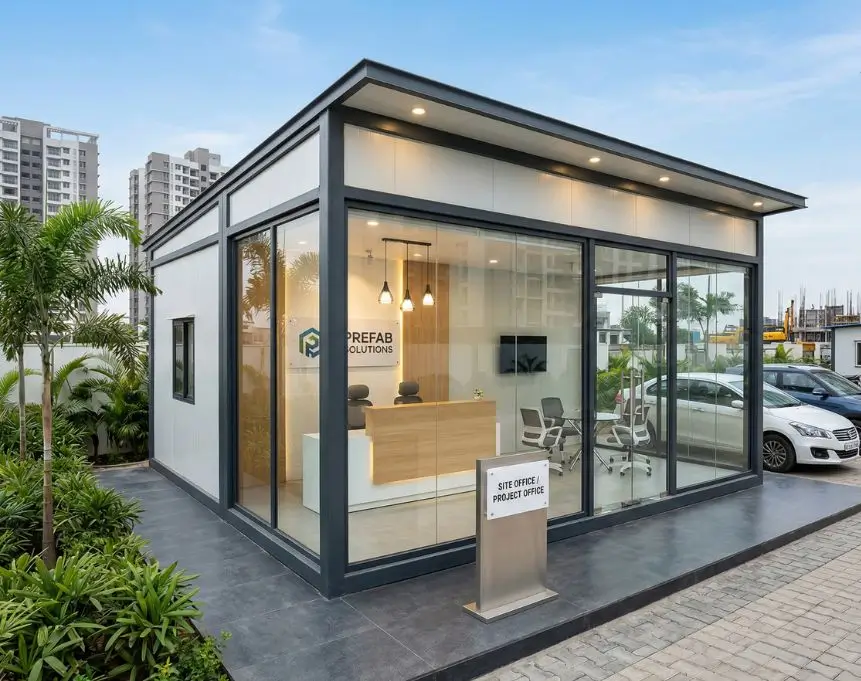
Affordable prefabricated buildings no longer mean boxy, dull structures; modern systems allow a wide range of layouts, elevations, and façade finishes. Using cold-formed steel frames and insulated sandwich panels, suppliers like Metal Tree can mix and match colours, textures, glazing, and internal partitions to suit industrial, commercial, residential, or institutional use cases.
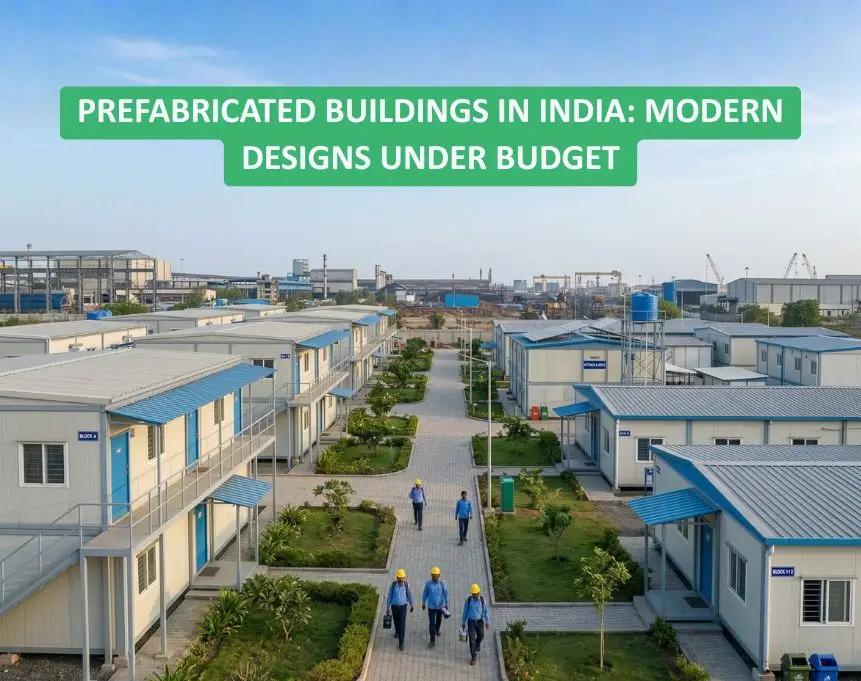
Worker housing and labour colonies
Low cost prefab homes India are widely used as labour accommodation on industrial and infrastructure sites because they can be installed quickly, expanded in modules, and relocated when a project shifts location. Single-storey or G+1 dormitory blocks with shared toilets, canteen buildings, and first-aid rooms can be laid out in neat clusters to create safe, hygienic worker communities.
A typical example is an EPC contractor building a highway stretch who needs to house 150 workers for 18 months; by opting for prefab accommodation blocks, toilets, and canteen facilities, the team can be housed within weeks with adequate thermal comfort and ventilation. When the project ends, the same modular buildings can be dismantled and transported to the next site, preserving the investment instead of abandoning permanent masonry structures.
For instance, a real estate developer launching a new township may use an elegant prefab marketing office with glass façades, air-conditioning, and branded interiors to host customers for one to two years, then move the unit to the next project. Because these budget modular buildings are factory finished, the brand presentation remains consistent and maintenance remains low across locations.
Commercial and institutional buildings
Prefabricated systems also work well for schools, healthcare facilities, retail blocks, and other institutional buildings that need fast expansion in growing neighbourhoods. Metal Tree designs pre-engineered commercial and institutional buildings with optimised spans, natural lighting, and energy-efficient envelopes to keep running costs under control.
A private school in a tier-2 city, for example, might opt for a prefabricated block to add eight new classrooms before the academic session starts, avoiding heavy civil work and lengthy approvals. Once student strength stabilises, the same modules can be repurposed as labs, libraries, or administrative spaces, showcasing how affordable prefabricated buildings support long-term flexibility.
Farmhouses, resorts, and vacation cottages
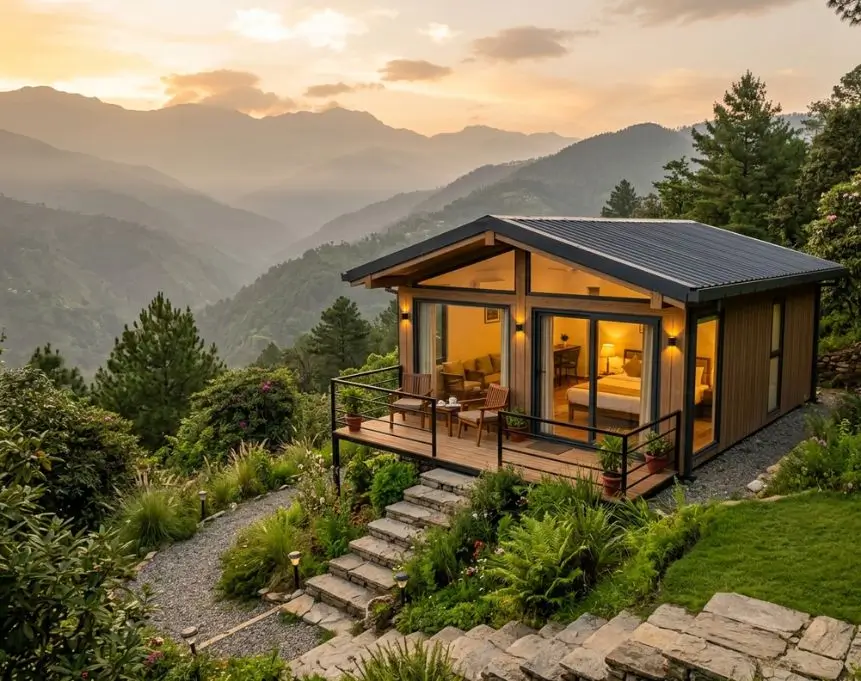
The rising interest in farmhouses, homestays, and boutique resorts has made prefab house cost India a hot topic for lifestyle buyers as well. Modular cottages with sloping roofs, wooden textures, and large windows can be configured as 1 BHK, 2 BHK, or 3 BHK units with verandas and decks, combining rapid construction with attractive aesthetics.
Many resort developers prefer affordable prefabricated buildings for new locations because they reduce environmental impact through minimal site disturbance, controlled waste, and efficient insulation. If a location underperforms in bookings, modules can be moved or resold, which is far harder with traditional construction.
Cost-Saving Tips
Keeping a prefab project within budget is not only about negotiating a lower square-foot rate; design decisions, material choices, and execution planning all influence the final figure. The following strategies help buyers extract maximum value from budget modular buildings while maintaining quality and safety.
Optimise size and layout
Firstly, define the functional requirement clearly before freezing the built-up area, because extra circulation spaces, odd-shaped rooms, or unnecessary widths quickly add cost. Secondly, standardising bay sizes, module widths, and room types allows the supplier to reuse structural members and panel sizes, which reduces fabrication complexity and waste.
For example, using repeated 10 ft or 12 ft module widths for low cost prefab homes India can cut steel tonnage and panel off-cuts compared to a fully custom grid with many variations. As a result, both material usage and erection time improve, bringing down the per sq ft cost without compromising functionality.
Choose the right specifications
Insulated sandwich panels, when sensibly specified, balance upfront cost with long-term energy savings in both hot and cold regions. For non-air-conditioned spaces such as warehouses or temporary storage, thinner panels may be adequate, while office, hospital, or accommodation areas benefit from better insulation and acoustic control to enhance comfort.
Doors, windows, flooring, and cladding finishes also offer a wide cost range; therefore, it helps to distinguish between must-have and nice-to-have items early in design discussions. Metal Tree’s design team often creates value-engineered options where structural integrity remains the same but alternate finishes reduce the total prefab house cost India without affecting safety.
Plan services and foundations smartly
Because prefabricated buildings are light compared to RCC, foundations can be simpler, using isolated footings, plinth beams, or even screw piles in some cases, subject to soil conditions and codes. Coordinating the column grid and building layout with plumbing, electrical, and HVAC routes in the design stage avoids site-level rework and keeps installation time under control.
In addition, phasing the project carefully can reduce idle time for cranes and labour, which directly affects project cost. When civil foundations are prepared while steel components and panels are being fabricated, overall project duration shrinks, enabling earlier use of the facility and faster revenue generation.
Work with experienced suppliers
While it may be tempting to pick the lowest quote, experienced suppliers of affordable prefabricated buildings often deliver better lifecycle value through design optimisation, quality control, and reliable after-sales service. A well-established company like Metal Tree brings integrated design, fabrication, and installation under one roof, reducing coordination gaps and hidden extras.
Checking reference projects, visiting existing installations, and reviewing material samples or mock-ups are practical ways to validate a supplier’s capability before placing the order. This due diligence helps ensure that low cost prefab homes India remain low cost over their entire life, not just at the purchase stage.
Best Suppliers
India has a growing ecosystem of manufacturers and fabricators providing affordable prefabricated buildings for industrial, commercial, and residential users. Within this ecosystem, the best partners combine strong engineering, custom design support, quality materials, and dependable installation teams. Metal Tree is one such integrated provider, offering design, fabrication, and on-site assembly of prefabricated and pre-engineered buildings from its base in Greater Noida to clients across the country.
What to look for in a prefab partner
- End-to-end capability: The ideal vendor handles structural design, detailing, fabrication, delivery, and erection, reducing interface risks between multiple agencies.
- Proven portfolio: Look for completed projects in warehouses, factories, site offices, accommodation blocks, or emergency buildings that resemble your requirements.
- Quality and safety standards: Adherence to codes, use of certified materials, and strong safety culture on sites are non-negotiable for long-lasting affordable prefabricated buildings.
- Design customisation: The supplier should be able to tweak layouts, module sizes, finishes, and insulation levels while keeping the structure economical and buildable.
- After-sales support: Access to maintenance guidance, spare panels, or expansion modules ensures that budget modular buildings remain serviceable for years.
Why Metal Tree stands out
Metal Tree specialises in a wide spectrum of prefabricated solutions including warehouses, factories, multistorey commercial blocks, labour colonies, site offices, institutional buildings, and emergency facilities. Its design philosophy emphasises innovation, sustainability, and precision, leveraging advanced software and 3D modelling to optimise steel weight, panel layouts, and service routing before fabrication begins.
By fabricating components in controlled facilities and following stringent quality checks, Metal Tree delivers durable, low-maintenance structures that perform reliably in diverse Indian climates. For clients focused on low cost prefab homes India or budget modular buildings, the company offers value-engineered options that balance cost, aesthetics, and performance, backed by professional installation teams and strong safety practices.
FAQs on Affordable Prefabricated Buildings in India
In many Indian projects, prefabricated buildings reduce overall cost by around 10 to 25 percent compared to conventional RCC, mainly due to faster completion, reduced material waste, and lower site labour requirements. However, the exact saving depends on design complexity, specification level, site location, and how efficiently the project is planned and executed.
Basic prefab houses, cabins, or small office units can often be installed and made operational within a few weeks once foundations are ready, because most components arrive ready to assemble. Larger industrial or institutional buildings may take a few months from design to handover, yet they still finish significantly faster than brick-and-mortar alternatives.
Modern prefab systems use steel frames, corrosion-resistant coatings, and insulated sandwich panels that are engineered for Indian wind, rain, heat, and in some cases seismic requirements. When designed and installed by experienced suppliers, these structures offer durable performance, comfortable interiors, and low maintenance needs across varied climates.
There is no strict minimum, but in practice, prefab becomes particularly cost-effective once the project crosses a few hundred square feet, such as a small site office, guard room, or single cottage. Larger campuses, worker colonies, warehouses, and institutional blocks gain even greater benefits from modular repetition and economies of scale.
Metal Tree can support the entire lifecycle of an affordable prefabricated building, from early concept and budgeting through detailed design, fabrication, logistics, installation, and future expansion. With experience in industrial, commercial, residential, and emergency applications, the team helps clients choose the right mix of cost, durability, and aesthetics for long-term value.