Prefabricated Buildings in India
Across India, manufacturing units, logistics parks, infrastructure contractors, and even institutions are under pressure to add new space quickly while keeping capital expenditure under control.
Delays due to labour shortages, weather, and site constraints can easily derail expansion plans or project timelines.
In this context, factory-made steel and insulated panel buildings offer a much faster, cleaner, and more predictable alternative for everything from industrial sheds to site offices and worker housing.
What Are Prefabricated Buildings?
In simple terms, prefabricated buildings (often called prefab buildings) are structures where major components—such as frames, wall panels, and roof systems—are manufactured in a factory and then transported to the site for quick assembly. These systems typically use cold-formed steel frames combined with insulated sandwich panels, creating lightweight yet strong envelopes that are ideal for both temporary and semi-permanent use. Because most of the work happens off-site in a controlled environment, quality is consistent, tolerances are tight, and project risks linked to weather and site conditions are significantly reduced. Factory-based production also means very little material wastage, since components are cut to precise sizes and standardised details, instead of being improvised on site. As a result, Indian businesses get faster, hassle-free installation and a more predictable outcome compared to traditional construction methods.
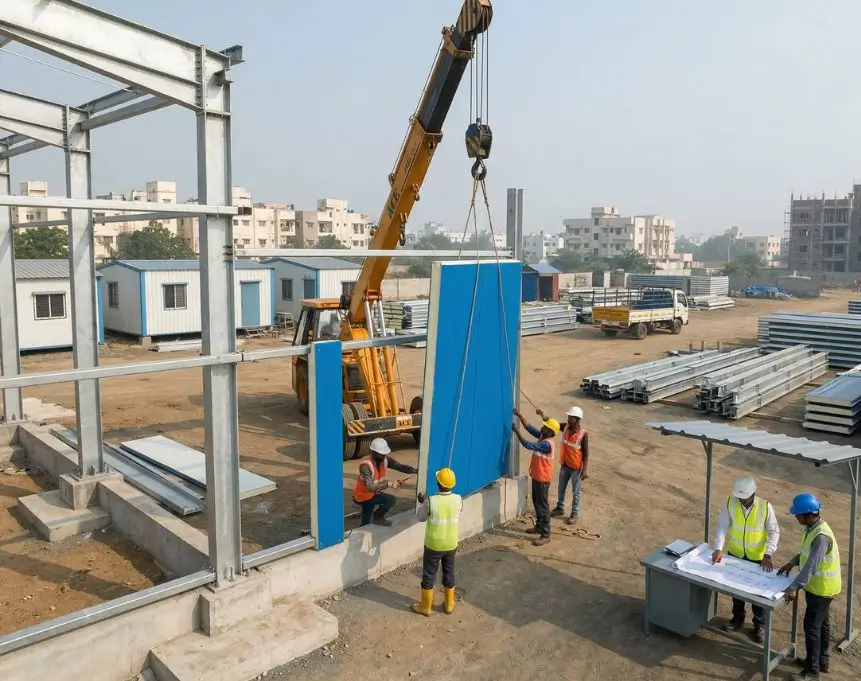
Prefabricated Buildings Types (modular, panel-built, steel frame)
Within prefabricated buildings in India, three broad technical approaches are widely used: modular units, panel-built systems, and steel frame structures.
Modular construction in India generally refers to fully or partially finished box-like units (modules) that are fabricated in the factory—including floors, walls, and roofs—and then connected on-site to create larger layouts such as offices, hostels, or classrooms.
Panel-built systems use individual wall, roof, and partition panels, typically made from insulated sandwich panels, that are fixed to a light steel or cold-formed framework. These are especially popular for canteens, toilet blocks, and small offices where thermal comfort and hygiene are critical. Finally, steel frame PEB structures use heavier primary and secondary steel members, combined with sheeting or insulated panels, to deliver long-span industrial and commercial buildings like warehouses, factory sheds, and multistorey facilities.
Advantages of Prefabricated Construction
One of the biggest advantages of prefabricated buildings in India is speed. Since structural members and panels are produced in the factory, on-site work is largely limited to foundations, bolting, and finishing, which can often be completed within days or weeks instead of months. This accelerated delivery directly translates into earlier commissioning, faster revenue generation, and lower financing costs for business owners.
Equally important, prefab construction is cost-effective because it reduces labour hours, cuts wastage, and benefits from economies of scale in factory production. Components are manufactured to standard patterns, which keeps mistakes low and allows better control over raw material utilisation. As a result, businesses often see lower overall project cost than with conventional RCC, especially when factoring in time saved and the ability to relocate or reconfigure structures later.
Beyond time and money, prefabricated systems also offer excellent thermal performance and durability. Steel frames combined with insulated panels provide strong resistance to corrosion, weather, and wear, while also maintaining comfortable interior temperatures in both hot and cold Indian climates, which helps reduce energy bills over the long term. Additionally, construction sites stay cleaner and safer because most cutting and welding happens in the factory, not at the project location.
Cost of Prefabricated Buildings
When people search for prefab building cost, they usually expect a single per-square-foot number, but real-world pricing in India depends on several variables.
The required span, height, location, loadings, finishes, and mechanical or electrical provisions all influence the final cost of a prefabricated building.
For example, a basic worker accommodation with simple finishes will naturally be more affordable than a high-end corporate office with premium interiors, false ceilings, and HVAC.
Even so, there are consistent cost drivers that make prefabricated buildings in India attractive.
- First, faster completion reduces indirect expenses like site overheads, supervision, and rental of temporary facilities.
- Second, factory-controlled cutting and fabrication sharply reduce wastage of steel, panels, and other materials, unlike conventional on-site work where offcuts and breakage can be significant.
- Third, the ability to dismantle and reuse structures—especially labour colonies, site offices, and portable cabins—means the effective life-cycle cost per project is far lower than a one-time-use RCC building.
Because of these factors, many Indian companies find that even if the initial quoted rate looks comparable to traditional construction, the true cost per year of use or per unit of productivity is significantly better with modern modular construction India solutions.
Top Prefabricated Building Companies in India
When you explore the market for prefabricated buildings in India, you will find a broad spectrum of suppliers—from large national PEB brands to regional steel fabricators and specialised prefab experts focused on end-to-end delivery.
The strongest players typically provide integrated services: design, engineering, fabrication, logistics, and on-site installation, all aligned to current Indian codes and safety standards.
Companies like Metal Tree position themselves as comprehensive partners, offering design excellence, precision fabrication, and professional installation for both pre-engineered and prefabricated buildings.
Rather than selling only components, such firms work closely with clients to optimise layout, select appropriate systems (from porta cabins to full-scale PEB structures), and deliver performance-tested solutions that meet industrial, commercial, or institutional needs across India.
While selecting from among the top prefabricated building companies in India, it is wise to look beyond just the initial quote.
It is far more useful to compare track record, engineering depth, fabrication quality, safety practices, and after‑sales responsiveness, because these are the factors that actually determine long-term value for your project.
Types of Prefabricated Structures
Under the broad umbrella of prefabricated buildings in India, different typologies have emerged to serve specific industrial and infrastructure needs. Rather than forcing one standard shed to fit every use case, prefab technology allows targeted solutions for each function, from heavy-duty industrial halls to compact sanitary blocks.
Site Infrastructures
Site infrastructure buildings include guard rooms, gate complexes, small control rooms, and utility enclosures that support larger construction or industrial projects. These are usually compact, rapidly deployable units that can be relocated or modified as the project evolves. Because they rely on light steel framing and insulated panels, they offer good weather protection while remaining easy to transport between sites.
Site Offices
Prefabricated site offices provide comfortable, functional workspaces for project managers, engineers, supervisors, and client teams close to the action on construction or industrial sites. These offices can be configured as single cabins or larger modular blocks with meeting rooms, reception areas, and storage, depending on project requirements. Additionally, insulated walls and proper ventilation make them far more usable in Indian summers than improvised tin sheds or temporary huts.
Labour Accommodations
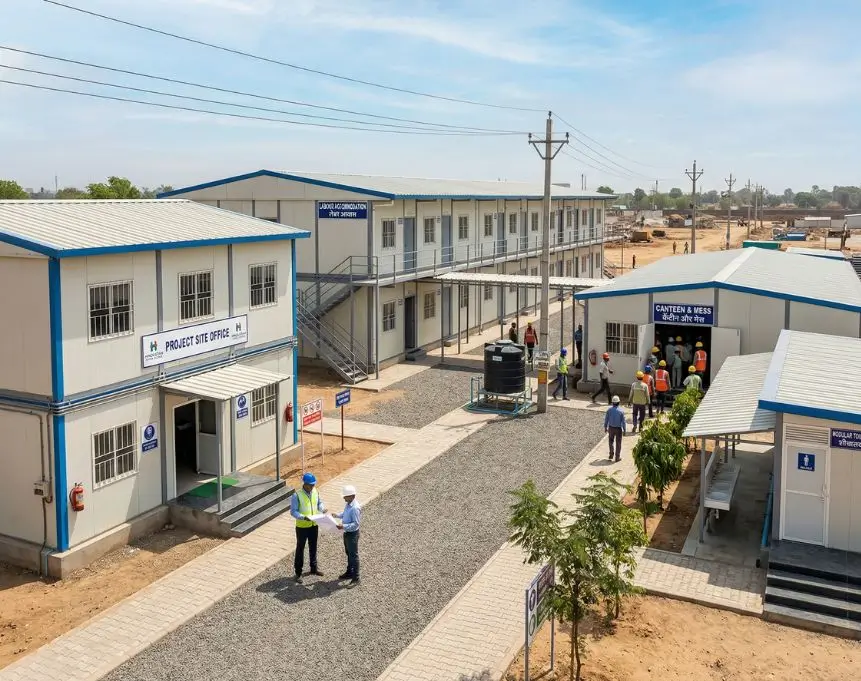
Prefab labour accommodation buildings are designed to house workers with safety, hygiene, and comfort in mind, which is crucial for productivity and welfare on large projects. Modular dormitories and bunk rooms can be expanded, stacked, or relocated as workforce size changes, while common areas like toilets, kitchens, and dining zones can be planned more efficiently than ad-hoc setups. Moreover, insulated panel construction ensures better thermal comfort and lower energy use compared to uninsulated structures.
Canteen Buildings
Canteen buildings created using panel-built systems give companies a hygienic, well-ventilated space for food preparation and dining, even in remote or temporary locations. These structures can incorporate kitchen equipment, serving counters, hand-wash areas, and adequate seating, all within a robust but lightweight envelope that is easy to clean and maintain. Because modular construction India techniques allow reconfiguration, canteens can be expanded as workforce or student numbers grow.
Toilet Blocks
Prefab toilet blocks are among the most impactful applications of prefabricated buildings in India, particularly for construction sites, industrial complexes, schools, and events. Factory-built wall and roof panels, combined with pre-planned plumbing layouts, lead to quick installation and easier maintenance than masonry toilets constructed in difficult conditions. Paired with proper ventilation and non-corrosive materials, these units significantly improve hygiene and worker morale.
Industrial Buildings
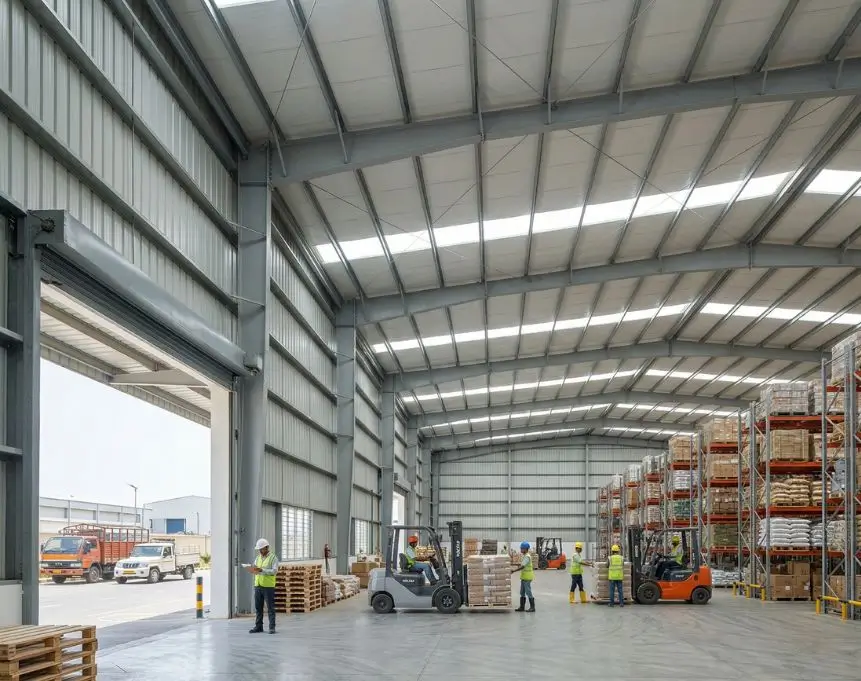
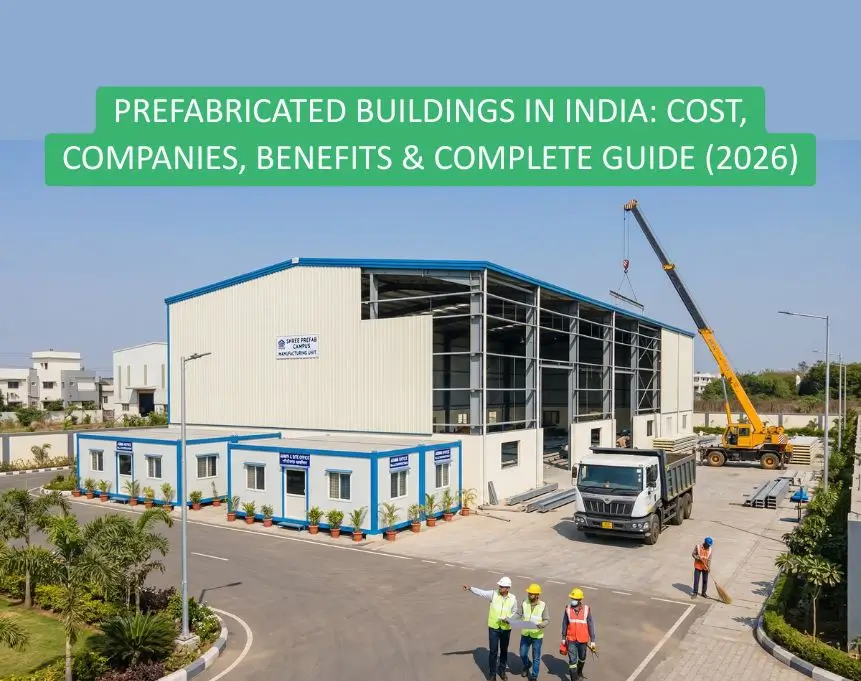
Industrial buildings—such as warehouses, processing plants, cold storages, and assembly lines—are where PEB structures really shine. Using pre-engineered primary steel frames, secondary members, and panel or sheeting systems, these buildings can effortlessly span large column-free spaces while supporting cranes, mezzanines, and heavy equipment. Furthermore, prefabricated industrial buildings can be customised for wind and seismic loads typical in different Indian regions, while still maintaining fast erection times.
Portable Cabins
Portable cabins, or porta cabins, are self-contained units used as offices, accommodation, ticket counters, or kiosks that can be lifted and shifted by crane or trailer. Since they are engineered as transportable modules, they are ideal for businesses that frequently move between sites or need flexible space that can be redeployed from one project to another. Besides, modern porta cabins come with insulation, electrification, and finishing options that make them feel surprisingly permanent and comfortable.
Steel Frame Prefab Structures
Steel frame prefab structures form the backbone of many modern PEB structures in India, combining high strength-to-weight ratios with excellent adaptability. Primary frames made from built-up or hot-rolled steel sections carry the main loads, while secondary purlins, girts, and bracings stabilise the overall system and support cladding or insulated panels. This arrangement allows designers to create wide spans, tall eaves, and complex roof geometries without the cost or time penalties of conventional RCC.
Because steel is inherently recyclable and compatible with bolted connections, steel frame prefabricated buildings in India can often be extended, reconfigured, or partially dismantled as business needs evolve. When paired with high-performance sandwich panels for walls and roofs, these structures achieve excellent thermal performance, acoustic control, and weather resistance, making them ideal for factories, warehouses, commercial complexes, and multistorey industrial buildings.
Construction Timeline
One of the most compelling reasons companies choose prefabricated buildings in India is the predictable and compressed construction timeline. The process usually begins with design and engineering, where detailed 3D models and structural drawings are created to optimise material usage, loading, and constructability. Because everything is pre-planned in software, clashes are resolved on screen instead of at the site, which saves substantial time later.
Once drawings are approved, fabrication of frames, panels, and accessories moves ahead in the factory while foundation work happens in parallel at the site. This overlap of off-site and on-site activities is a key reason modular construction India projects finish faster than traditional ones, where each stage often must wait for the previous one to be completed. After components are delivered, experienced erection teams can assemble the building quickly using cranes, bolting, and minimal on-site welding, followed by interiors and services.
Because all critical elements are standardised and pre-engineered, the risk of last-minute surprises, rework, or material shortages is far lower than with conventional civil work. Consequently, project owners get clearer timelines, smoother coordination, and more reliable handover dates, which are essential for planning production or operations.
How to Choose a Manufacturer
Selecting the right partner for prefabricated buildings in India can make the difference between a smooth, on-time project and a frustrating experience. First, evaluate the manufacturer’s end-to-end capability: design, fabrication, and installation should ideally be handled by a single coordinated team, rather than fragmented across multiple vendors. This integrated approach ensures that what is engineered on paper can actually be produced and erected efficiently in the field.
Second, look closely at technical depth and quality systems. A strong prefab or PEB structures supplier will have experienced structural engineers, advanced design software, certified welders, and robust quality checks for incoming material, fabrication, and final dispatch. It is also wise to visit reference projects to see how their buildings have performed over time, particularly in terms of corrosion resistance, leakage control, and overall user comfort. Finally, consider service attitude and after‑sales support. Since prefabricated buildings may need modifications, extensions, or relocation later, it is important to work with a manufacturer—such as Metal Tree—that stays engaged beyond handover and can respond quickly when your requirements evolve. Transparent communication on design options, realistic scheduling, and safety standards during erection should be non‑negotiable criteria in your selection process.
FAQs
With proper design, quality steel, and insulated panels, prefabricated buildings in India can deliver service lives similar to conventional structures, especially when regular maintenance and repainting are carried out. Because materials like steel and high-grade coatings are resistant to corrosion and wear, well-designed PEB structures can operate reliably for decades in Indian conditions.
Although many people associate modular construction India solutions with temporary facilities, modern prefabricated systems are widely used for permanent industrial, commercial, and institutional buildings. By choosing appropriate steel sections, panel specifications, and foundations, businesses can create long-term assets while still preserving the flexibility to expand or modify in the future.
Prefab building cost is often lower on a life-cycle basis because construction is faster, wastage is reduced, and structures can be relocated or reused across multiple projects. Moreover, off-site manufacturing means fewer labourers are needed on site and overheads like temporary accommodation, scaffolding, and shuttering are significantly reduced.
Yes, one of the major strengths of prefabricated buildings in India is design flexibility. Layouts, spans, heights, cladding, insulation levels, and interiors can all be tailored to suit your process flow, branding, and comfort expectations. Manufacturers like Metal Tree routinely customise portacabins, canteens, toilet blocks, institutional buildings, and full-scale industrial PEB structures for diverse sectors.
Prefab construction is inherently more sustainable because it minimises material waste, uses recyclable steel and panels, and allows buildings to be dismantled instead of demolished. Additionally, insulated sandwich panels improve energy efficiency by reducing heat gain and loss, which lowers the operational carbon footprint over the building’s life.