Building an industrial warehouse is one of the most significant capital investments your business will make. Unlike smaller construction projects, a warehouse is the operational heart of your logistics, storage, or distribution operations—every decision you make during the selection process will impact your facility's performance, durability, and profitability for the next 25 to 40 years.
Yet here's the challenge: most business owners approach warehouse construction the same way they might hire a general contractor for a home renovation. They gather a few quotes, compare prices, and pick the lowest bid. That approach works fine for residential projects. For industrial warehouses, it's a recipe for disaster.
Choosing the wrong warehouse builder can cost you ₹50 to ₹100+ lakhs in unexpected expenses, not to mention months of delays, quality issues, and operational headaches. The right contractor, by contrast, can deliver your facility 12 to 16 weeks faster, save 30-40 percent on construction costs, and build a structure that performs flawlessly for decades. The difference lies in knowing exactly what to evaluate, which questions to ask, and which warning signs to watch for. This guide walks you through the entire contractor selection process—from initial research to final contract signing—with a detailed checklist, evaluation framework, and proven red flag indicators.
Part 1: Understanding Your Options - Traditional vs. Modern Warehouse Builders
Before you begin evaluating contractors, understand that not all warehouse builders operate the same way. The construction methods they specialize in fundamentally shape their capabilities, timelines, and costs.
Traditional RCC (Reinforced Cement Concrete) Builders
Traditional warehouse contractors typically use site-based construction methods: pouring concrete foundations, erecting reinforced concrete columns and beams, and completing finishing work on-site. This approach is conventional, familiar, and—often—slow and expensive.
Characteristics:
- Extended project timelines (24-36 weeks typical)
- Higher material waste (15-20% typical)
- Higher labor requirements and cost
- Weather-dependent construction schedule
- Greater on-site quality variability
Modern PEB (Pre-Engineered Building) Manufacturers
Progressive warehouse builders now specialize in Pre-Engineered Building systems. Components are factory-fabricated with precision, then assembled on-site—a fundamentally different approach that compresses timelines and reduces costs dramatically.
Characteristics:
- Accelerated project completion (8-12 weeks typical)
- Minimal material waste (2-5% typical)
- Factory-controlled quality standards
- Parallel processing (fabrication while site prep occurs)
- Superior durability and long-term value
For most warehouse operators in India, partnering with a modern PEB manufacturer delivers measurably better results than traditional builders. However, not all PEB manufacturers operate with equivalent expertise and professionalism.

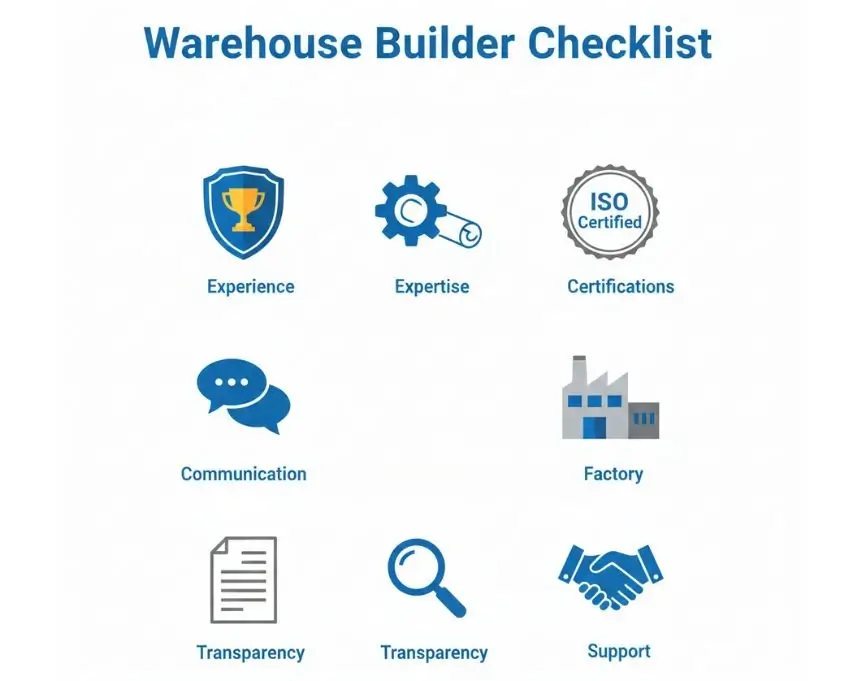
Part 2: The Checklist — Seven Essential Evaluation Criteria
When evaluating warehouse builders, use this comprehensive checklist to assess each candidate objectively.
1. Experience and Track Record
What to look for:
- Minimum 10-15 years of warehouse construction experience
- Portfolio of 20-50+ completed warehouse projects in the last five years
- Projects similar in scope and scale to your planned facility
- Case studies demonstrating on-time, on-budget delivery
- Documented client testimonials from businesses in your industry
Evaluation questions:
- How many warehouse projects have you completed in the last five years?
- Can you show me three projects that are similar to mine in size and complexity?
- How many of those projects were completed on schedule and within budget?
- Do you have client references I can contact directly?
Red flag indicators:
- Fewer than five years of warehouse construction experience
- Portfolio dominated by non-warehouse projects
- Reluctance to provide references or past client contact information
- Unwillingness to discuss project timelines or budgets
- References who are unavailable or unwilling to discuss their experience
A reputable contractor will have extensive documentation of past projects and actively encourage reference verification. If they're vague about their history or defensive about past work, that's a warning sign.
2. Technical Expertise and Specialization
What to look for:
- Specialized knowledge in warehouse-specific design (clear spans, loading dock optimization, storage layout, operational flow)
- In-house engineering team with CAD/CAM capabilities
- Understanding of local building codes and regulatory requirements
- Experience with your specific warehouse type (cold storage, e-commerce fulfillment, FMCG storage, etc.)
- Knowledge of advanced construction technology and innovative solutions
Evaluation questions:
- Do you have an in-house design engineering team?
- How do you optimize warehouse layouts for operational efficiency?
- What experience do you have with [your specific warehouse type]?
- How do you ensure compliance with local building codes and regulations?
- What innovations do you implement to improve construction efficiency?
Red flag indicators:
- No in-house engineers or design capability
- Inability to articulate warehouse-specific design principles
- Vague answers about how they approach layout optimization
- No mention of regulatory compliance or building code knowledge
- Treating your warehouse like a generic industrial building
A specialized warehouse builder understands that layout, column spacing, dock configuration, and ceiling height aren't afterthoughts—they're foundational design decisions that impact your operational efficiency for decades.
3. Certifications and Compliance Standards
What to look for:
- ISO 9001 (quality management) certification
- ISO 14001 (environmental management) certification
- OSHA or equivalent safety standards compliance
- Compliance with relevant Indian Standards (IS 800 for steel, IS 875 for loads, IS 1893 for seismic design)
- Fire safety and building code compliance certification
- Professional affiliations with industry bodies
Evaluation questions:
- What ISO certifications do you hold?
- How do you ensure compliance with IS standards for steel construction?
- What fire safety standards do your warehouses meet?
- How do you document and verify compliance throughout the project?
Red flag indicators:
- No ISO certifications or unwillingness to discuss them
- Cannot provide documentation of building code compliance
- Vague about quality control procedures
- No written quality assurance protocols
- Missing structural drawings and bill of quantities (BOQ) documents
Certifications matter because they indicate systematic quality control, documented processes, and a commitment to industry standards. A builder without certifications may be cutting corners on quality and regulatory compliance.
4. Manufacturing Infrastructure and Capacity
What to look for:
- Dedicated fabrication facility with modern equipment
- CNC cutting and automated welding systems
- Documented monthly production capacity
- Clear fabrication timelines for projects
- Inventory of standard components to expedite delivery
- Technology infrastructure for BIM (Building Information Modeling) compatibility
Evaluation questions:
- Can I visit your fabrication facility?
- What is your current monthly production capacity?
- What equipment do you use for cutting and welding?
- What is your typical fabrication timeline for a [size] warehouse?
- Do you maintain inventory of standard components?
Red flag indicators:
- Unwillingness to allow facility visits
- Vague about production capacity or timelines
- Use of outdated or manual fabrication equipment
- Subcontracting all manufacturing to third parties
- No documented quality control in the manufacturing process
Your builder's manufacturing capability directly impacts your project timeline. Modern equipment, adequate capacity, and efficient processes separate professional builders from amateurs.

5. Communication and Project Management
What to look for:
- Documented project management processes and protocols
- Clear lines of communication and defined points of contact
- Use of modern project tracking tools and software
- Transparent cost reporting and timeline tracking
- Regular status updates and milestone reviews
- Proactive problem-solving approach
Evaluation questions:
- How do you communicate project status to clients?
- What tools do you use for project tracking and cost management?
- How frequently do you provide updates?
- What is your process for handling change requests?
- How do you handle unexpected issues or delays?
Red flag indicators:
- Slow or inconsistent response times to inquiries
- No documented communication protocol
- Unwillingness to discuss project management processes
- No project tracking tools or real-time visibility
- Defensive attitude toward questions about timeline or costs
Poor communication is the #1 cause of construction project dissatisfaction. A builder who responds promptly, explains technical details clearly, and keeps you informed throughout the project is worth paying premium rates for.
6. Financial Transparency and Pricing
What to look for:
- Itemized cost breakdown (materials, labor, equipment, overhead)
- Clear payment schedule tied to project milestones
- Reasonable upfront deposit (typically 25-30% of contract value)
- Fixed-price contract or clearly defined cost escalation clauses
- Transparent change order pricing process
- No hidden fees or surprise costs
Evaluation questions:
- Can you provide a detailed breakdown of your cost estimate?
- What is your payment schedule?
- What is your policy on change orders and pricing?
- Are there any costs not included in your quote?
- What contingency buffer do you include in the timeline?
Red flag indicators:
- Unrealistically low bids (30-40% below market rate)
- Requesting full payment upfront
- Refusing to accept checks or standard payment methods
- Vague cost estimates without itemization
- Significant cost discrepancies between multiple bids from same contractor
- Reluctance to discuss hidden costs or change order procedures
A bid that's dramatically lower than competitive alternatives often indicates that the contractor is either inexperienced, undercapitalized, or planning to cut corners on quality. Comparing three to five detailed bids from qualified builders ensures you understand the market rate.
7. Post-Construction Support and Warranty
What to look for:
- Comprehensive warranty coverage (structural, weatherproofing, finishes)
- Clear warranty terms and duration (typically 2-5 years)
- Documented maintenance and support procedures
- Response protocols for defects or issues
- Training on facility operation and maintenance
- Availability for future expansions or modifications
Evaluation questions:
- What warranty does your company provide after handover?
- How long is the warranty period?
- What is included in the warranty coverage?
- What is your response time for warranty claims?
- Can you support future expansions or modifications to the facility?
Red flag indicators:
- No warranty mentioned or extremely limited coverage
- Unwillingness to provide post-project support
- Vague about warranty terms or conditions
- No documented maintenance procedures
- Difficulty reaching the contractor after project completion
A good builder doesn't disappear after handing over the keys. They stand behind their work and support you through the initial operational phase, ensuring everything functions as designed.
Part 3: The Selection Process — Step-by-Step Implementation
Step 1: Initial Research and Shortlisting (Week 1-2)
Activities:
- Identify 3-5 potential warehouse builders through referrals, industry associations, and online research
- Review each builder's website, portfolio, and past project case studies
- Check certifications, credentials, and professional affiliations
- Read online reviews and testimonials (while recognizing potential bias)
- Request preliminary information packages and capability documents
- Conduct initial phone screening to assess communication and professionalism
Outcome: Narrow down to 3 most promising candidates for detailed evaluation
Step 2: Detailed Technical and Financial Assessment (Week 3-4)
Activities:
- Request detailed quotations with itemized cost breakdowns
- Schedule facility visits to see the builder's fabrication facility
- Request portfolio of projects matching your warehouse type
- Conduct reference calls to 3-4 past clients
- Request copies of certifications and compliance documentation
- Assess technical capability through specific design questions
- Evaluate project management systems and processes
Questions to ask references:
- Was the builder responsive to your questions and concerns?
- Did the project stay within budget?
- Was the facility delivered on the agreed timeline?
- What was the quality of workmanship?
- Have you experienced any issues post-completion?
- Would you recommend this builder for your next project?
Outcome: Comprehensive comparative assessment of all three candidates
Step 3: Competitive Bid Analysis (Week 5)
Activities:
- Compare cost breakdowns across all three builders
- Evaluate technical specifications and quality differences
- Assess timeline proposals for feasibility
- Analyze payment schedule and terms
- Calculate total cost of ownership (including warranty, maintenance, future support)
- Negotiate final terms with the top-ranked candidate
Important: Don't select the lowest bidder automatically. Analyze why bids differ. A builder 20-30% cheaper than competitors may be planning to cut corners on quality, labor, or material standards. Conversely, a builder 50% more expensive than competitors may be overcharging without delivering proportional added value.
Outcome: Identify your preferred partner and negotiate final contract terms
Step 4: Contract Finalization and Kickoff (Week 6)
Activities:
- Review and finalize contract terms with your legal counsel
- Establish communication protocols and reporting schedule
- Confirm payment schedule and milestone definitions
- Define change order procedures and approval process
- Clarify scope of work and project deliverables
- Schedule project kickoff meeting and site handover
Critical contract elements:
- Clear project scope and deliverables
- Fixed completion date with penalty for delays
- Detailed cost breakdown and payment schedule
- Change order process and pricing procedures
- Warranty coverage and post-construction support
- Communication protocols and escalation procedures
- Insurance and liability coverage requirements
Outcome: Signed contract and commencement of construction with clear expectations
Part 4: Red Flags — Critical Warning Signs to Avoid
Understanding these red flag categories helps you identify problematic contractors before you're contractually committed.
Experience and Capability Red Flags
- Less than 5 years of warehouse construction experience
- Portfolio dominated by non-warehouse project types
- Inability to provide multiple references from similar projects
- Dismissive attitude toward your specific requirements
- Vague about technical capabilities or specialized expertise
- No evidence of experience with your warehouse type
Quality and Certification Red Flags
- No ISO or quality certifications (ISO 9001, ISO 14001)
- Cannot provide copies of relevant compliance certifications
- No documented quality control procedures
- Missing structural drawings or detailed bill of quantities (BOQ)
- Vague about how they ensure building code compliance
- No formal quality assurance protocols documented
Communication and Process Red Flags
- Slow or inconsistent response to email and phone inquiries
- Vague or evasive answers to technical questions
- No documented project management process
- Unwillingness to discuss past project timelines or issues
- Defensive attitude when asked about quality or delays
- Pressure tactics during negotiation ("You need to decide today")
Financial Red Flags
- Bids 40-50% below competitive alternatives (suggests corners being cut)
- Requesting 50-100% payment upfront
- Unwilling to accept checks or standard payment methods
- No itemized cost breakdown provided
- Vague about what costs are or aren't included
- Large discrepancies between different bids from the same contractor
- Hidden fees or surprise costs mentioned casually
Contract Red Flags
- Vague or non-existent written contract
- No clear timeline defined in the agreement
- Ambiguous scope of work or deliverables
- No documented change order procedure
- Unclear payment schedule or milestone definitions
- No warranty coverage mentioned
- Unclear responsibility for permits and regulatory compliance
Project Management Red Flags
- History of missed deadlines on past projects
- Previous projects that experienced significant budget overruns (>15%)
- Negative online reviews citing delays or quality issues
- Unwilling to discuss past projects honestly
- No software tools or systems for project tracking
- Large number of concurrent projects suggesting overextension
Manufacturing and Facility Red Flags
- Unwillingness to allow facility visits
- Vague about production capacity or lead times
- Outdated equipment or manual fabrication processes
- Subcontracting all manufacturing without oversight
- No documented quality control in manufacturing
- Inconsistent delivery timelines across different projects
Part 5: PEB Manufacturer Selection - Additional Considerations
If you're considering Pre-Engineered Building manufacturers (which we recommend for most modern warehouse projects), add these specific evaluation criteria:
PEB-Specific Technical Capabilities
- Seismic Design Compliance: Can they design for IS 1893 earthquake standards applicable to your region?
- Steel Grade Standards: Do they use appropriate steel grades (IS 2062, ASTM A572)?
- Precision Manufacturing: What tolerances do they maintain (±1-2mm is the standard)?
- Customization: Can they adapt standard PEB designs to your specific requirements?
- Automation: Do they use CNC cutting and robotic welding for precision?
PEB-Specific Questions
- How many PEB warehouses have you manufactured?
- What is your typical fabrication timeline?
- Do you maintain inventory of standard components?
- What customization options are available within your standard designs?
- What warranty do you provide on fabrication quality?
- Can you accommodate future expansions or modifications?
Why PEB Manufacturers Often Excel
Modern PEB manufacturers typically outperform traditional builders because:
- Factory-controlled quality exceeds on-site construction precision
- Modular design enables faster assembly (2-3 weeks vs. 8-10 weeks for traditional structure)
- Parallel processing (fabrication while site prep occurs) compresses total timeline
- Standardized processes reduce errors and rework
- Cost advantages of 30-40% versus traditional RCC construction
- Better long-term durability and lower maintenance requirements
Part 6: Making Your Final Decision
After completing your evaluation, use this decision matrix to synthesize your findings:
Evaluation Scoring Matrix
Rate each candidate (1-5 scale) on:
- Experience and track record (weight: 20%)
- Technical expertise and capability (weight: 20%)
- Communication and project management (weight: 15%)
- Financial value and transparency (weight: 20%)
- Quality standards and certifications (weight: 15%)
- Post-construction support (weight: 10%)
Calculate weighted score: (Score × Weight) for each category, then sum total.
The highest-scoring candidate should be your preferred partner, provided they don't exhibit any critical red flags that disqualify them.
Conclusion
Choosing the right industrial warehouse builder is arguably the most important decision you'll make in setting up your facility. The difference between a good builder and a poor one extends far beyond the initial construction phase—it impacts your operational efficiency, maintenance costs, expansion capabilities, and long-term facility performance for 25 to 40 years.
By using this comprehensive checklist, following the structured evaluation process, and vigilantly watching for red flags, you'll partner with a professional who delivers on-time, on-budget, and with superior quality. At Metal Tree, we've worked with hundreds of industrial businesses across India to deliver warehouse solutions that exceed expectations. Our approach combines decades of PEB manufacturing expertise with transparent communication, documented quality standards, and unwavering commitment to client satisfaction. If you're evaluating warehouse builders, we'd welcome the opportunity to demonstrate how our capabilities, experience, and track record can deliver exceptional value for your project.
Frequently Asked Questions
A: Typically 6 weeks: 2 weeks for research and shortlisting, 2 weeks for detailed evaluation, 1 week for bid analysis, and 1 week for contract finalization. Rushing this process leads to poor decisions.
A: PEB warehouses typically cost 30-40% less than traditional RCC construction, with 8-12 week timelines versus 24-36 weeks. For a 20,000 sq ft facility, this translates to ₹1-₹1.6 crore in direct cost savings, plus additional financing and overhead savings.
A: We recommend evaluating 3-5 qualified candidates. This provides sufficient comparison without creating decision paralysis. Fewer than three limits your perspective; more than five becomes administratively cumbersome.
A: Don't prioritize one over others. A truly professional builder delivers all three: competitive pricing, on-time completion, and superior quality. If a builder forces you to choose between them, it's a red flag.
A: Very important. Warranties protect you from defects and demonstrate the builder's confidence in their work. Insist on clear warranty terms covering structural elements, weatherproofing, and finishes for a minimum of 2-3 years.
A: Yes. Modular PEB design enables future expansions without disrupting existing operations. This is one of the significant advantages of PEB warehouses over traditional RCC construction.
Ready to Start Your Warehouse Project?
At Metal Tree, we specialize in delivering innovative, durable, and cost-effective pre-engineered warehouses tailored to your operational needs. Our team of experienced engineers, project managers, and field technicians ensures precision and quality at every step—from design consultation through final handover and beyond. Whether you need a cold storage facility, e-commerce fulfillment center, FMCG warehouse, or logistics distribution hub, we're equipped to deliver exceptional results.
Contact Metal Tree today to discuss your warehouse project. Request a consultation with our technical team and discover how our expertise, transparency, and commitment to excellence can transform your warehouse vision into reality.
Let's build something great together.
📞 Call us today
+91 93116 24628
📧 Email your inquiry
info@metaltree.in