
Across India, many growing businesses face a similar problem: they know demand is rising, but their buildings are not ready on time. A manufacturing company may win a large order yet wait months for its new shed to be completed, while a logistics firm might struggle to add a warehouse quickly enough near a new highway corridor. Delays in traditional brick-and-mortar construction lead to lost revenue, missed opportunities, and higher project costs at a time when every week counts.
In this environment, pre-engineered buildings are changing how Indian businesses and institutions think about infrastructure. Instead of building everything from scratch on-site, key components are manufactured in a factory, shipped to the location, and assembled rapidly with minimal disruption. As a result, companies across industries—from factories and warehouses to schools, hospitals, and airports—are turning to pre-engineered buildings to keep projects on schedule and budgets under control.
What Are Pre-Engineered Buildings?
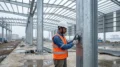
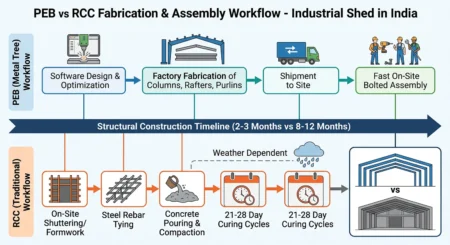
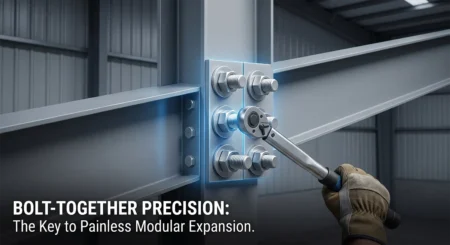
Pre-engineered buildings (PEBs) are steel structures in which primary members like columns, rafters, purlins, and roof or wall panels are designed and fabricated in a controlled factory environment and then bolted together at site. This model replaces slow, labour-heavy on-site construction with fast, precision-made assemblies that fit together with high accuracy, similar to a well-planned kit of parts.
Because major steel components are manufactured to exact specifications, PEB projects see far less material wastage and fewer site errors than conventional methods. At the same time, this method allows large clear spans, high roof heights, flexible interior layouts, and easy provisions for cranes, mezzanines, and future expansion—making PEBs suitable for many different industries.
Industrial Manufacturing: Factory & Production Buildings
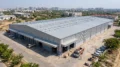
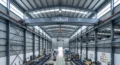
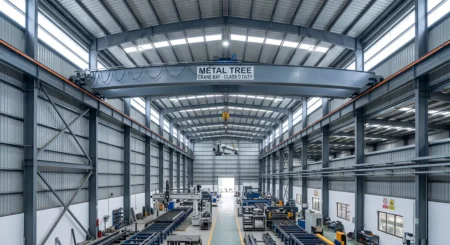
For industrial manufacturing, pre-engineered factory buildings have become a natural fit because they combine speed, strength, and custom layout options. These factory PEBs in India are typically built with high-strength steel frames, long clear spans, and robust roofing and wall systems designed for heavy machinery, production lines, and storage.
Key industrial uses include:
- Manufacturing plants for sectors like textiles, engineering, automotive, electronics, food processing, and pharmaceuticals
- Assembly line facilities requiring long, unobstructed bays
- Combined production and warehousing units where movement of goods must remain smooth and efficient
These PEB factory buildings are engineered to handle high loads, vibrations, and occasional seismic activity, while also offering options like insulated panels, natural lighting systems, and energy-efficient cladding to reduce long-term operating costs. Because components are pre-designed and fabricated offsite, project timelines are significantly shorter, helping factories start or expand production faster and at more predictable cost.
Warehousing & Logistics: Storage, Cold Chain & Distribution
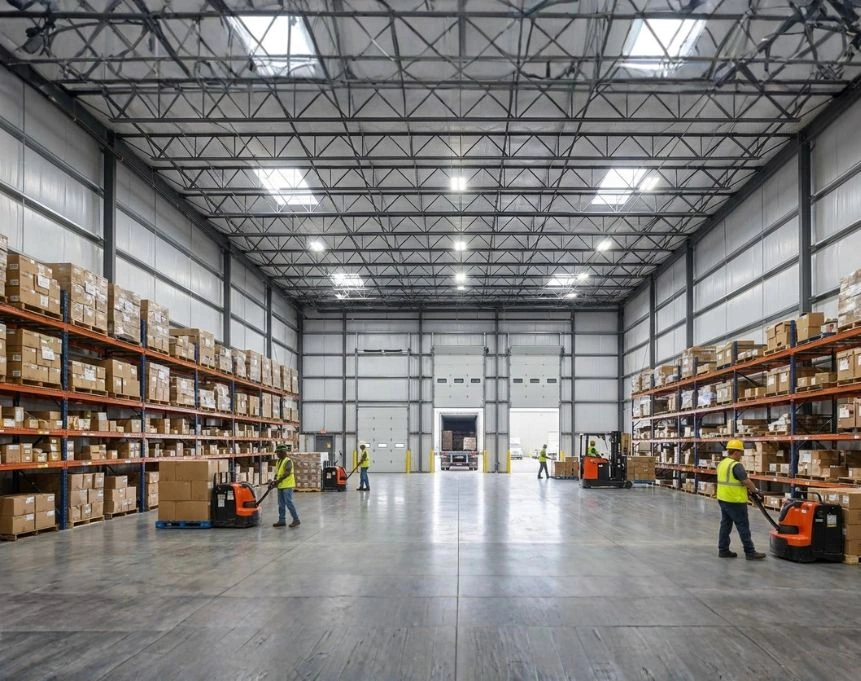
Warehousing and logistics is one of the fastest-growing application areas for pre-engineered buildings in India. PEB warehouses are designed as large-span, column-free buildings that maximise usable storage volume and support efficient movement of goods.
Common warehouse PEB types include:
- General storage warehouses for FMCG, retail, and industrial goods
- E-commerce fulfilment centres and distribution hubs
- Agricultural godowns and grain storage structures
- Cold storage buildings using insulated roof and wall panels
These PEB warehouses typically feature wide clear spans, high racking height potential, optional crane systems, and engineered ventilation and fire safety provisions. Because the buildings are fabricated and pre-punched in the manufacturing facility and then assembled on-site, many warehouse projects can move from design to commissioning in a matter of weeks, not months. This speed is especially valuable for logistics companies and 3PL providers who must respond quickly to new routes, new customers, and shifting demand patterns.
Commercial PEB Buildings: Offices, Showrooms & Retail
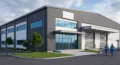
Pre-engineered commercial buildings allow businesses to create modern, visually appealing offices and customer-facing spaces without long construction delays. These commercial PEBs are designed for corporate offices, retail outlets, showrooms, service centres, small malls, and mixed commercial spaces across India.
These commercial PEBs typically combine:
- Flexible, open-plan floor plates for offices, co-working spaces, or showrooms
- Architectural façades using glass, cladding, or composite panels for a branded look
- Energy-efficient roofing, insulation, and natural lighting to keep operating costs low
Because the structural system is pre-engineered, clients can focus more on layout, interiors, and customer experience while still getting the benefits of faster construction and lower overall cost. For many growing Indian businesses, PEB commercial buildings offer a smart way to expand or upgrade their brand presence while keeping capital expenditure under control.
Multistorey Pre-Engineered Buildings
Pre-engineered construction is not limited to single-storey sheds; it is also used for multistorey steel buildings in urban and semi-urban projects. These pre-engineered multistorey buildings are especially relevant where land is limited but the need for built-up area is high, such as in city centres or industrial townships.
Typical multistorey PEB uses include:
- Office towers and commercial complexes
- Residential and mixed-use developments
- Institutional and administrative blocks requiring multiple floors
By using a pre-engineered steel frame, floors can be designed with large column-free spaces and adaptable layouts, enabling tenants or owners to reconfigure internal spaces over time. Faster construction cycles, reduced dead weight compared to conventional RCC, and the ability to integrate glass façades and modern cladding systems all make multistorey PEBs an attractive option for developers and end-users.
Institutional PEB Buildings: Schools, Colleges & Government
Institutional projects—schools, colleges, universities, government offices, community centres, and research facilities—often have strict budgets and timelines. Pre-engineered institutional buildings are designed to deliver safe, durable, and expandable infrastructure for education and public services.
These buildings can include:
- Classroom blocks, lecture halls, labs, and libraries
- Administrative offices and examination centres
- Community centres, auditoriums, and training facilities
Because PEB institutional buildings are manufactured offsite and assembled quickly, schools and government agencies can add new blocks or renovate existing campuses with minimal disruption to day-to-day activities. They also benefit from energy-efficient options like insulated panels, reflective roofing, and natural lighting, which help keep long-term utility bills and carbon footprint in check.
Portable & Prefabricated PEB Structures
Portable pre-engineered buildings offer a practical solution when the requirement is temporary, semi-permanent, or likely to move from one site to another. These are typically prefabricated portable units built using steel frames and insulated or non-insulated wall panels.
Popular portable PEB applications include:
- Portacabins for site offices, project management rooms, and security cabins
- Marketing offices and sales lounges at project or event locations
- Canteen buildings and dining spaces for industrial and construction workers
- Toilet blocks and sanitation units for remote sites and large events
- Rooftop structures for additional office or storage space on existing buildings
These units are manufactured in a factory and delivered in ready-to-install or knock-down form, making them extremely fast to deploy and easy to relocate when needed. For companies managing multiple sites or time-bound projects, portable PEB solutions provide excellent flexibility with professional, comfortable interiors.
Emergency & Disaster-Relief PEB Buildings
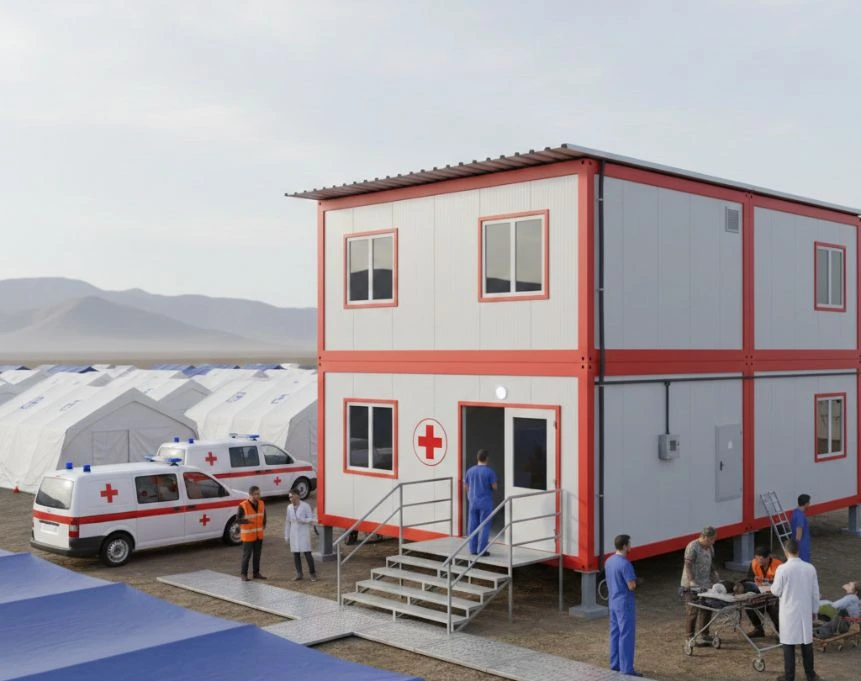
In emergencies such as floods, earthquakes, pandemics, or large infrastructure failures, the priority is to create safe spaces quickly. Emergency buildings based on PEB technology are pre-engineered, lightweight steel structures with insulated sandwich panels that can be deployed rapidly in critical situations.
Typical emergency PEB applications are:
- Disaster relief shelters and temporary housing
- Field hospitals, isolation wards, and medical camps
- Temporary classrooms or training centres in affected areas
- Site offices, dormitories, and support buildings for emergency projects
These emergency buildings are designed for quick installation, relocatability, and reuse, often scalable up to multiple floors. Their insulated panels provide good thermal performance, which is essential when power availability is limited or weather conditions are extreme. For governments, NGOs, and private companies involved in relief and rapid-deployment projects, such pre-engineered emergency buildings offer a proven, reliable solution.
Infrastructure & Civic PEB Buildings
Pre-engineered buildings are also widely used in infrastructure and civic projects where large spans, fast execution, and long life are critical. Infrastructure PEB buildings are deployed for airports, railway facilities, transport terminals, utility buildings, and other public infrastructure across India.
Common infrastructure-related PEB structures include:
- Airport hangars, terminal support buildings, and cargo sheds
- Railway sheds, maintenance depots, and platform covers
- Utility buildings, depots, and storage for public works departments
- Government service centres and multi-purpose public halls
These projects benefit from the strength and durability of galvanized steel, corrosion-resistant cladding, and low maintenance requirements typical of well-designed PEBs. Because many infrastructure works must be built or upgraded without major service disruptions, the speed and predictability of pre-engineered construction is a significant advantage.
Why So Many Industries Prefer PEBs
Across all these sectors—industrial, logistics, commercial, institutional, portable, emergency, and infrastructure—CFOs, project heads, and owners are choosing pre-engineered buildings for a similar set of reasons:
- Faster project completion: Factory fabrication and bolt-together erection can cut total project time dramatically compared to traditional construction.
- Lower overall cost: Reduced material waste, shorter labour durations, and optimised steel design make PEBs highly cost-effective over the project lifecycle.
- Design flexibility and scalability: PEBs can be customised for crane loads, mezzanines, future extensions, and industry-specific layouts.
- Strength, safety, and durability: High-strength steel, engineered connections, and quality-controlled production deliver long service life with minimal maintenance.
- Better energy performance: When combined with insulated sandwich panels and proper ventilation, PEBs support energy-efficient and comfortable interiors.
For a specialist company like Metal Tree, which focuses on pre-engineered, prefabricated, and insulated building systems, this means being able to serve many different industries with tailored, yet efficiently produced, building solutions.
FAQs: Pre-Engineered Buildings by Industry
Q1. Which industries benefit the most from pre-engineered buildings?
Industries such as manufacturing, warehousing, logistics, retail, commercial, educational, institutional, agriculture, infrastructure, and defense all benefit from PEBs because they need large, durable spaces that can be built quickly.
Q2. Are PEBs suitable only for industrial sheds and warehouses?
No, modern PEBs are used for commercial offices, showrooms, multistorey buildings, schools, colleges, hospitals, community centres, portable cabins, and emergency facilities in addition to warehouses and factories.
Q3. How do pre-engineered buildings perform in extreme weather or seismic zones?
Properly designed PEBs use high-strength steel and engineered connections that can be sized for wind, snow, and seismic loads according to relevant codes, and they often include corrosion-resistant cladding for long life in harsh conditions.
Q4. Can a PEB be customised for my specific process or equipment?
Yes, PEBs can be customised for span, height, crane beams, mezzanine floors, dock planning, and internal layouts, so the building supports your machinery, workflow, and future expansion plans.
Q5. How fast can a typical PEB project be delivered?
Timelines depend on size and complexity, but many PEB warehouses, factories, and portable units can move from design approval to installation in a few weeks, with larger institutional or multistorey projects often completing much faster than equivalent RCC buildings.