Steel recovery rates in structural applications now sit above 95% globally, which means almost none of the metal in a well-designed building ever becomes landfill. That single fact is quietly reshaping how enterprises in India plan their next facility.
If your company is chasing a LEED or IGBC certificate, or simply trying to shrink the carbon line on next year’s ESG report, the material and method you choose matters more than the paint color on the wall. This is where Pre-Engineered Buildings (PEB) earn their place – and where Metal Tree, as a PEB manufacturer based in India, has built its entire design philosophy around measurable sustainability rather than marketing claims.
Key Takeaways
- Structural steel is recovered and recycled at rates above 95%, versus concrete and masonry debris that mostly ends up as landfill.
- India’s PEB market is projected to grow from roughly USD 2.3 billion in 2025 to USD 6.46 billion by 2034, driven partly by green-building demand.
- Reflective “cool roof” systems can cut peak ambient surface temperatures by 2–5°C , directly countering the urban heat island effect.
- Construction activity contributes an estimated 8.4% of PM2.5 and close to 21% of PM10 emissions in Delhi alone – factory-built PEB components sidestep most of this.
- Metal Tree engineers every shed, warehouse, and industrial building to align with LEED and IGBC documentation requirements from the design stage, not as an afterthought.
Why Are MNCs Rethinking Construction Materials in India?
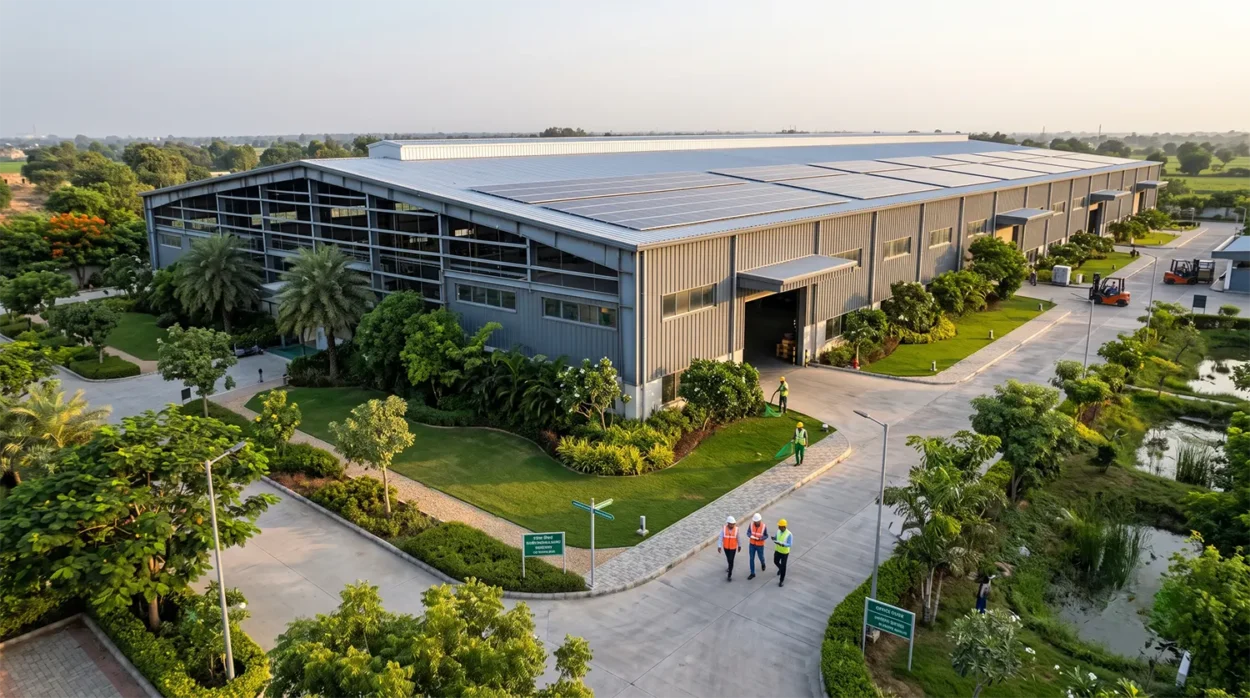
Global capital expenditure decisions increasingly run through sustainability committees before they reach a construction site. Corporate occupiers with LEED or IGBC mandates cannot simply bolt solar panels onto a conventional RCC shed and call it green – the entire build process gets scored, from raw material sourcing to jobsite emissions.
India’s PEB market itself reflects this shift. Industry analysis puts the market at approximately USD 2.26–2.3 billion in 2025, expanding at a compound annual growth rate near 12.38% through 2034. That growth isn’t happening in a vacuum. It’s being pulled forward by PLI-linked factory construction, data center build-outs, and – increasingly – by procurement teams who need a certifiable sustainability story for the building itself, not just its operations. For an MNC evaluating a new warehouse, plant, or logistics hub, that changes the conversation from “what does it cost per square foot” to “what does it cost the planet, and can we prove it.” Metal Tree structures every proposal to answer that second question directly.
Is Structural Steel Actually Recyclable, or Is That a Marketing Line?
It’s real, and the numbers are stronger than most people assume. Recovery rates for structural steel – through reuse and recycling combined – exceed 95% globally, and recycling steel emits only around 20% of the carbon that primary steel production does. Steel doesn’t degrade in quality when it’s melted down and reformed, which is why it can cycle through building after building indefinitely.
Compare that to a demolished RCC structure. Concrete and masonry debris is heavy, difficult to separate, and mostly ends up in landfill or low-value fill. Steel, by contrast, walks off the demolition site as scrap with real resale value – nothing is left un-salvaged.
This is the core reason recyclable steel buildings sit at the center of Metal Tree’s pitch to enterprise clients. Every PEB frame we fabricate is, in effect, a bank of recoverable material. When a facility is eventually expanded, relocated, or decommissioned decades from now, the steel doesn’t become waste – it becomes the next project’s raw material.
How Much Water Does PEB Construction Actually Save?
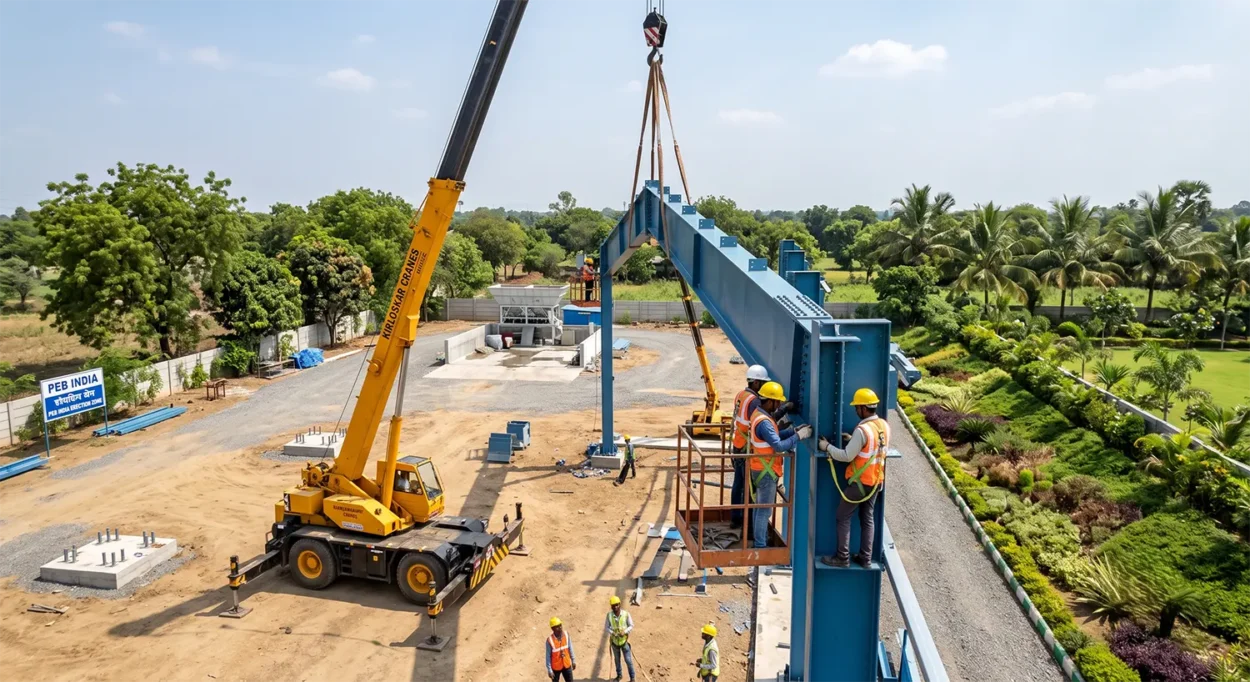
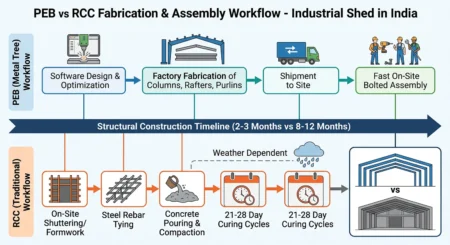
Quite a lot, because there’s barely any wet trade work happening on-site. Conventional RCC construction depends on large volumes of water for mixing and curing concrete, and that demand intensifies in regions already under water stress. PEB components, by contrast, are fabricated in a controlled factory environment and simply bolted together on site – cement is largely limited to the foundation.
For enterprises with ESG water-footprint targets, that’s not a minor detail – it’s one of the more defensible, easily quantified wins in the whole sustainability pitch. Lower site-level water demand also means fewer disruptions to local supply during construction, which matters increasingly in Indian industrial corridors where water access is already contested between residential and commercial use. Metal Tree’s factory-first fabrication model is built specifically to push as much of the “wet work” off the jobsite as possible, leaving only foundation-related concrete work to be managed locally.
Why Does PEB Construction Generate So Much Less Dust?
Because most of the building is never cut, welded, or ground on-site in the first place. Indian metros already carry a heavy dust burden from construction: activity-based studies estimate construction contributes roughly 8.4% of PM2.5 and close to 21% of PM10 emissions in Delhi, with a comparable 9% share of total particulate emissions in Mumbai. Real-time monitors near active sites in NCR routinely record PM10 readings of 300–600 µg/m³, several times above the safe limit.
Prefabrication sidesteps most of this exposure. Components arrive cut, drilled, and coated from the factory, so on-site work is largely limited to erection and bolting rather than grinding and wet-mixing. That’s a meaningful advantage during Delhi-NCR’s GRAP restriction periods, when conventional sites face work stoppages but factory-built assembly can often continue. For enterprises in worker-safety-conscious sectors like pharma or electronics manufacturing, less on-site dust also means fewer respiratory exposure risks for the erection crew – a detail that shows up in health and safety audits as much as environmental ones.
What Is a “Cool Roof” and Why Does It Matter for Eco-Friendly Industrial Sheds?
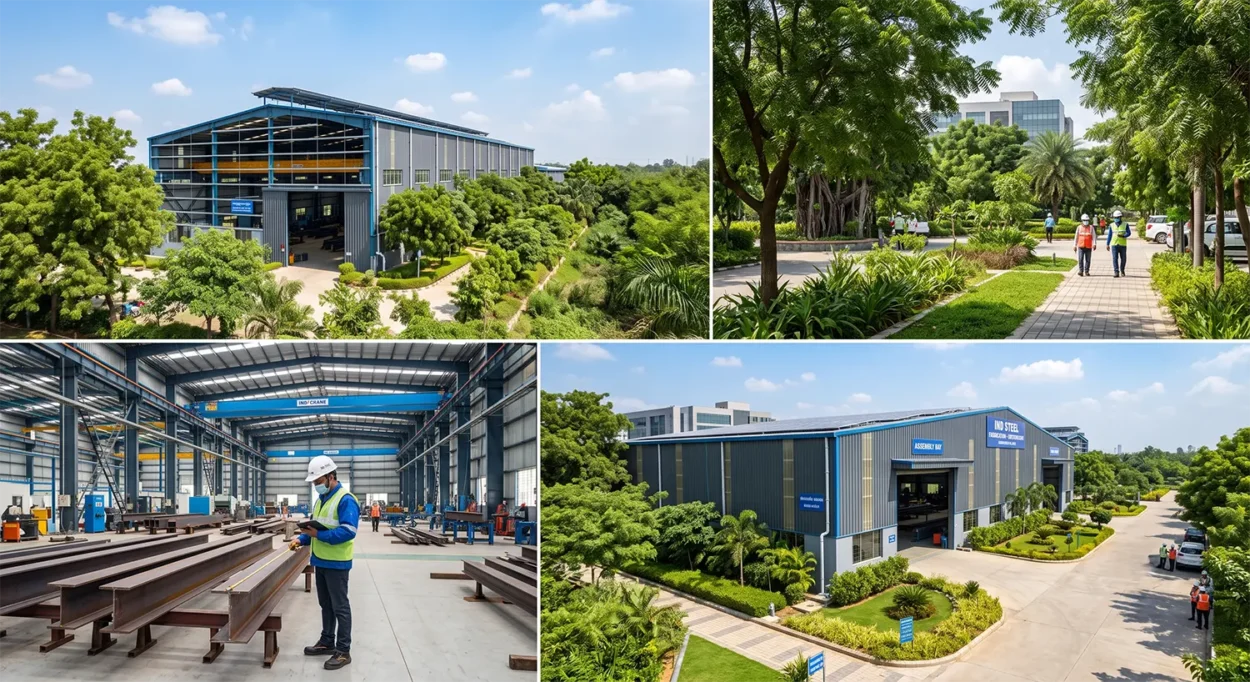
A cool roof uses a highly reflective surface finish that bounces solar radiation back rather than absorbing it, and the effect on surface and ambient temperature is significant: high-reflectance roofing and pavement can lower peak ambient temperatures by 2–5°C compared to conventional dark roofing. Given that Indian cities are seeing summer peaks push past 50°C in built-up zones, that difference is not cosmetic – it directly affects cooling loads, worker comfort inside the shed, and the surrounding neighborhood’s contribution to the urban heat island effect.
The Indian Green Building Council recognizes this at the certification level too, awarding heat-island-mitigation credits tied to reflective roofing and vegetated roof area. Because a PEB roof is a factory-engineered steel panel to begin with, adding a high-SRI (Solar Reflectance Index) cool-roof coating is a straightforward specification decision – not a retrofit project.
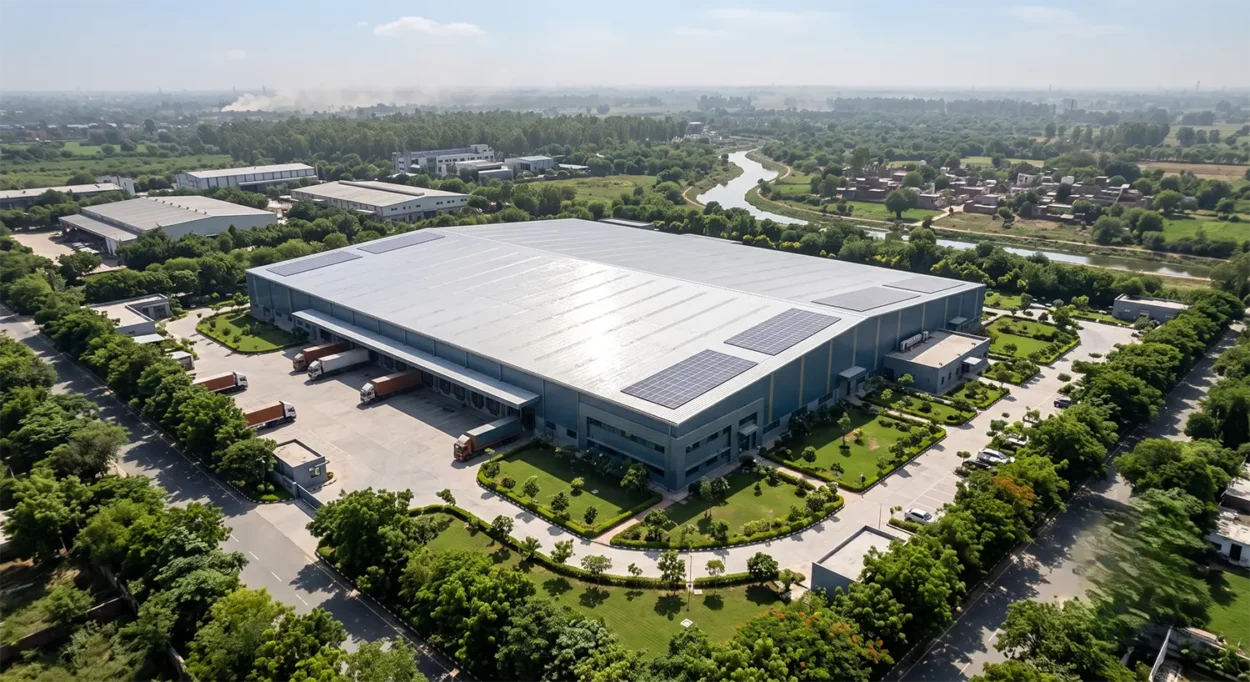
Metal Tree offers cool-roof panel finishes as a standard specification option precisely because it’s one of the more direct, low-friction ways to accumulate green-building credits without changing the building’s footprint or structural design.
How Does PEB Support LEED and IGBC Certification Goals?
By generating the kind of documentable, third-party-verifiable data that certification assessors actually want to see: recycled steel content, reduced site water consumption, lower particulate emissions during construction, and reflective roofing with a known Solar Reflectance Index. Rather than treating certification as a checklist applied after the building is designed, Metal Tree’s engineering process captures this data at the specification stage – recycled content percentages, water-use estimates, and roofing SRI values – so the paperwork exists before the first steel column ever leaves the factory.
For an MNC with a group-wide sustainability mandate, that upfront documentation often shortens the certification timeline considerably, since assessors aren’t reconstructing material data after the fact.
Metal Tree’s Approach: Engineering Sustainability In, Not Bolting It On
Metal Tree has spent years fabricating PEB structures for industrial, warehousing, and commercial clients across India, and the pattern we keep seeing is this: sustainability performs best when it’s a design input, not a marketing layer added at handover. Every project we quote includes recycled-steel content data, projected water savings versus an equivalent RCC build, and cool-roof SRI specifications as standard line items – because that’s the information procurement and sustainability teams actually need to move a project through internal approval.
Across recent Metal Tree industrial shed projects, clients pursuing IGBC pre-certification have consistently cited faster documentation turnaround as a direct result of having recycled-content and water-use figures available at the quotation stage rather than requested after fabrication began. This is also why enterprises come back to Metal Tree for multi-site rollouts – once the sustainability data model exists for one facility, replicating it across a second or third site is far faster than starting from scratch with a new contractor each time.
Frequently Asked Questions
Yes. PEB projects can contribute credits under materials (recycled steel content), water efficiency (reduced curing-water demand), and heat-island reduction (reflective roofing), since structural steel recovery rates exceed 95% and cool roofs cut peak surface temperatures by 2–5°C.
There’s no single universal percentage, but the mechanism is well documented: RCC construction needs large volumes of water for mixing and curing, while PEB assembly is largely dry, factory-fabricated work with cement use confined mostly to the foundation.
Generally, yes. Steel recycling emits roughly 20% of the carbon associated with primary steel production, and studies suggest steel-framed builds can offer meaningful CO2 reductions compared to concrete-heavy alternatives during construction and demolition.
Because construction-linked particulate matter is a measurable share of urban air pollution – around 8.4% of PM2.5 and nearly 21% of PM10 in Delhi – and it’s also a compliance risk, since GRAP restrictions can halt conventional site work during high-pollution periods, which factory-built PEB assembly is less exposed to.
A cool roof is a roofing surface engineered with high solar reflectance so it absorbs less heat than standard roofing, reducing peak ambient temperatures by 2–5°C . On a PEB structure, it’s typically a panel-coating specification decision made at the design stage, so the added cost is far smaller than retrofitting an existing conventional roof later.
Bringing It Together
Sustainable construction in India is no longer a bolt-on certificate chased after the building is finished – it’s a specification decision made before the first steel column is cut. Recyclable steel buildings, reduced site water demand, lower dust generation, and cool-roof thermal performance all compound into a stronger LEED or IGBC submission, and a genuinely smaller environmental footprint.
Metal Tree builds every eco-friendly industrial shed, warehouse, and commercial PEB structure with that documentation and design intent from day one. If your team is evaluating a new facility against a green-building mandate, that’s the conversation worth having before ground ever breaks.