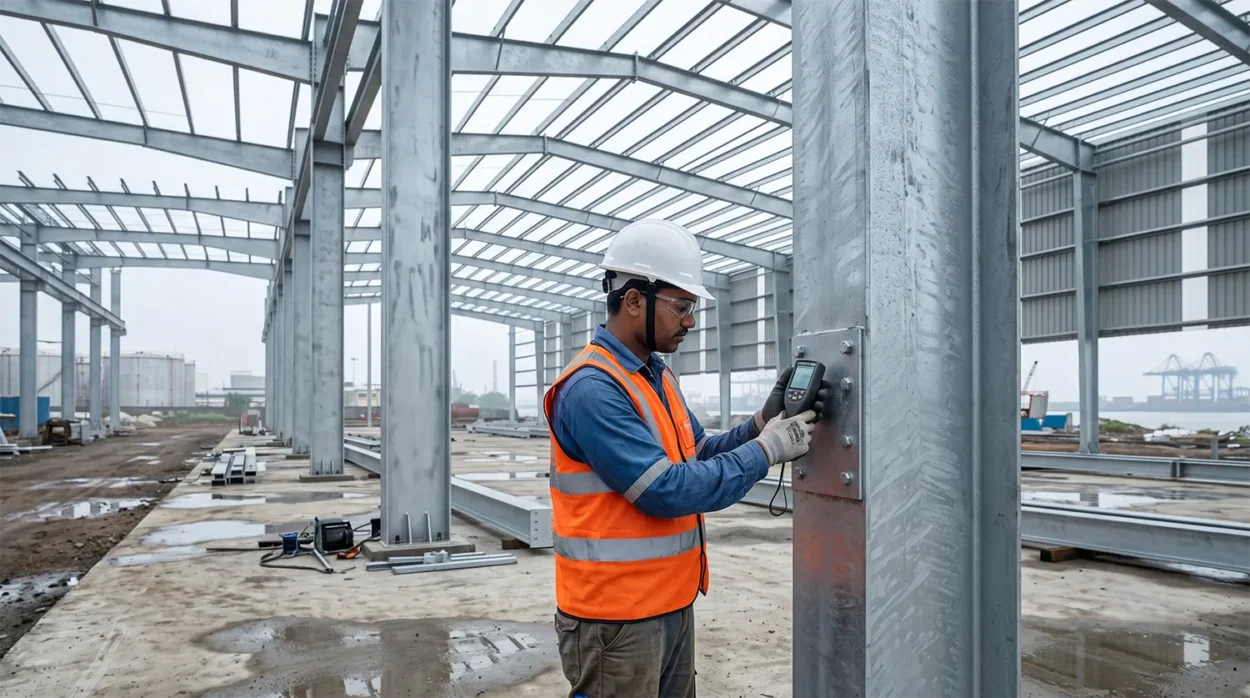
India’s pre-engineered buildings market crossed USD 2.26 billion in 2025 and is on track to hit USD 6.46 billion by 2034, growing at a 12.38% CAGR . That kind of growth has pulled in a flood of new fabricators – some excellent, many cutting corners buyers won’t notice until the first monsoon or the first tremor. We’ve inspected enough failed sheds and cracked purlins to know exactly where budgets quietly turn into liabilities.
This isn’t a generic buyer’s checklist. It’s an insider’s account of the seven mistakes that cost Indian developers, factory owners, and warehouse operators the most – and what separates a PEB company worth trusting from one that just looks the part on a glossy brochure.
Key Takeaways
- India’s PEB market is growing at 12.38% CAGR, reaching $6.46B by 2034 – more buyers means more unqualified vendors entering the space.
- Steel structure already holds 52.6% product share in India’s PEB market, making steel grade verification the single highest-leverage check a buyer can make.
- Skipping IS 875 (Part 3) wind load and IS 1893 seismic checks is the most common – and most dangerous – shortcut low-cost fabricators take.
- Hot-dip galvanized steel can last 40 to 70 years versus a 5–10 year repaint cycle for basic primer paint, per industry corrosion-protection benchmarks.
- Metal Tree builds every structure to IS 800, IS 875, and IS 1893 as a baseline, not an upsell.
Why Is PEB Vendor Selection Getting Riskier in India? (Rising Market Demand)
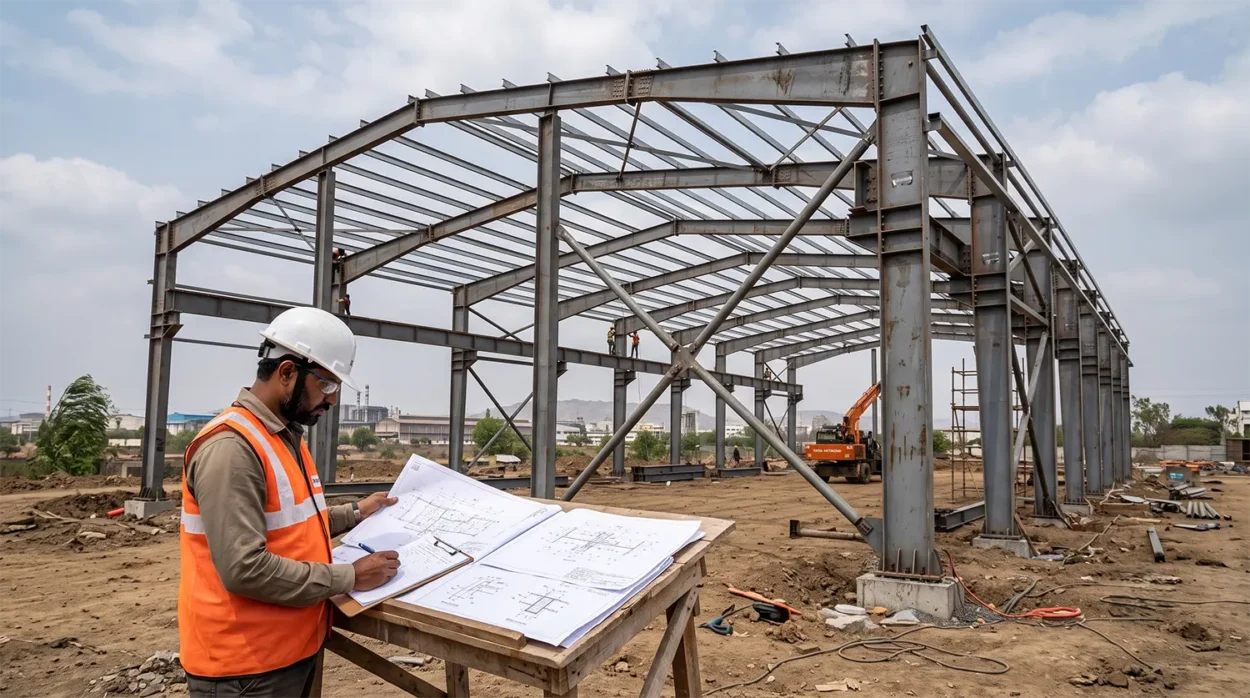
Steel structure alone commands a 52.6% product share of India’s PEB market, and the industrial segment holds roughly 48.7% of end-use demand . That surge is being fed by the PLI scheme’s factory build-outs, the National Logistics Policy’s warehousing push, and India’s Rs 11.11 lakh crore capital expenditure allocation for infrastructure.
Here’s the problem: demand is scaling faster than the number of genuinely qualified fabricators. When a market grows this fast, new entrants without proper design offices, testing protocols, or IS-code discipline start quoting aggressively low prices – and buyers who compare quotes without comparing quality standards end up paying for it in year three or four, not year one. Isn’t it worth asking why one quote is 20% cheaper than the rest before you sign it? Usually the answer sits in one of the seven places below.
Mistake 1: Choosing on Price Alone and Ignoring Steel Grade
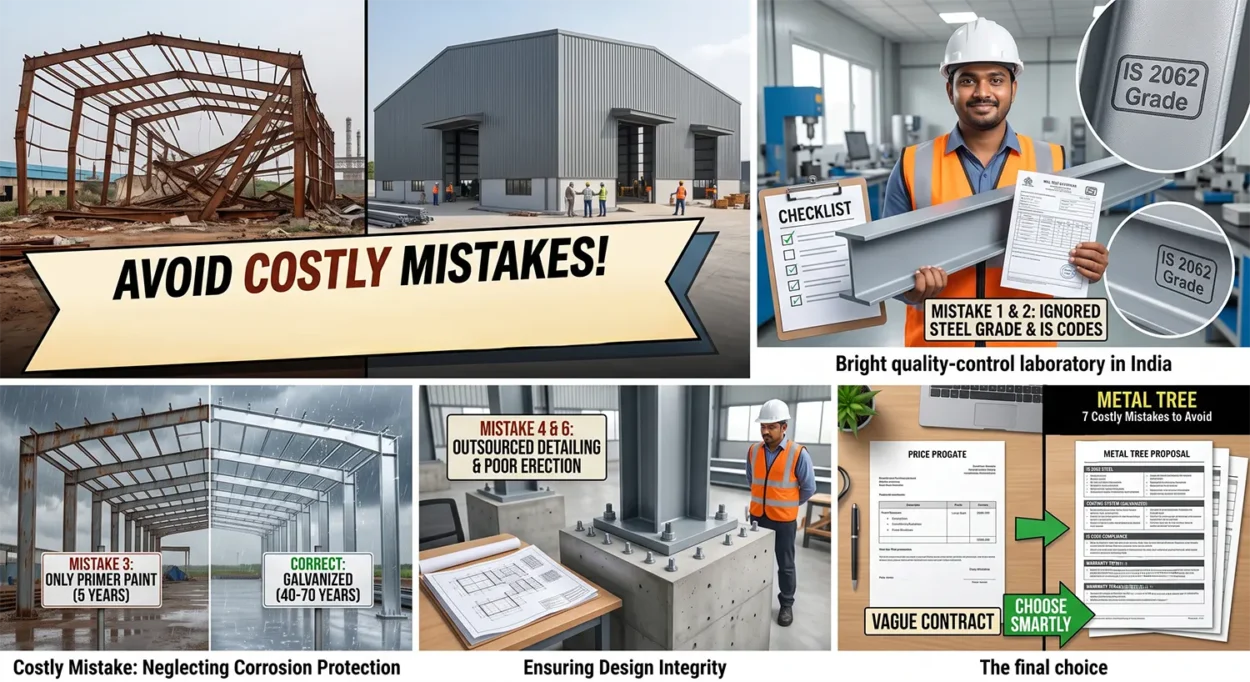
The most expensive PEB mistake in India is treating steel as a commodity instead of a specification. Structural steel used in PEBs typically needs to meet IS 2062 grade requirements for yield strength and weldability – but lower-tier fabricators often substitute re-rolled or secondary steel to hit an aggressive quote.
The tell-tale signs: no mill test certificates, no traceability to a named steel producer, and a quoted tonnage that’s suspiciously light for the building’s span and bay spacing. Thinner sections deflect more under load, fatigue faster at welds, and can fail the very wind and seismic checks discussed next.
A genuine PEB quote should always list the steel grade, source mill, and section-by-section tonnage breakdown – not just a lump-sum “structural steel” line item. If a vendor won’t share this, that’s your answer.
At Metal Tree, every primary and secondary member is fabricated from certified structural steel with full mill test certificates provided to the client before dispatch – because a PEB company’s real product isn’t steel, it’s accountability for that steel.
Mistake 2: How Do You Verify IS Code Compliance for Wind and Seismic Loads?
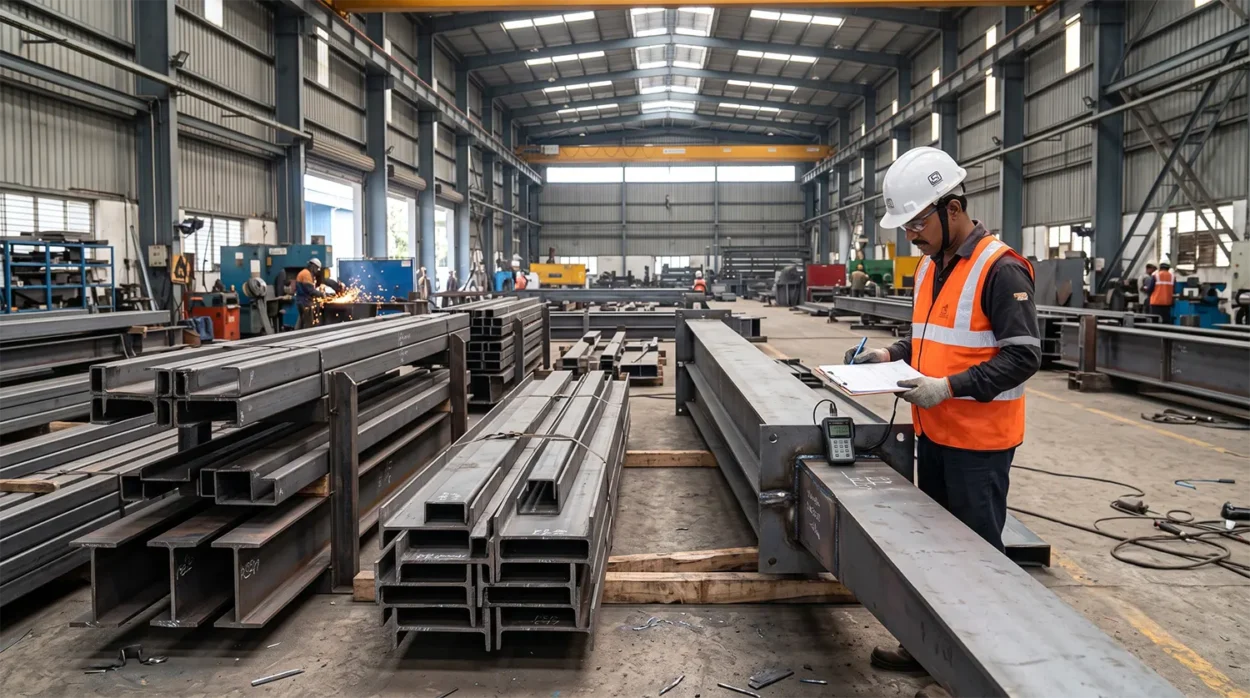
Every PEB frame in India should be designed against IS 875 (Part 3) for wind loads and IS 1893 (Part 1) for seismic loads, with the base steel design governed by IS 800 (ANALYSIS OF PEB UNDER SEISMIC AND WIND LOAD, IRJMETS 2026). This isn’t a nice-to-have – it’s the calculation that determines column spacing, bracing, and roof uplift resistance for your specific site and wind zone.
Here’s where it goes wrong: some fabricators run a single “standard” design across every project regardless of whether the site sits in a coastal cyclone belt, a Zone IV/V seismic region, or a calm inland plain. A structure engineered for Pune’s wind zone will not perform the same way in a coastal facility in Gujarat or a high-seismic-zone plant in the Himalayan foothills.
A rhetorical question worth asking every quote: which wind zone and seismic zone was this design actually calculated for, and can I see the load calculation report? If a fabricator hesitates, that’s a red flag, not a formality.
Metal Tree’s engineering team runs a project-specific IS 875 and IS 1893 load analysis for every structure – factoring local wind speed, terrain category, and seismic zone – before a single column is fabricated. This is how genuine PEB quality standards are supposed to work: designed for the site, not copied from the last one.
Mistake 3: Why Does Corrosion Protection Make or Break a PEB’s Lifespan?
Hot-dip galvanized steel structures can last 40 to 70 years with minimal upkeep, while structures relying on basic primer paint typically need repainting every 5 to 10 years depending on exposure . That gap in maintenance cost compounds fast across a factory shed’s 25–30 year operating life.
Painting isn’t inherently wrong – for indoor architectural steelwork it’s a legitimate, cost-efficient choice. The mistake is when a fabricator applies a thin single-coat primer to exterior structural members in a coastal, chemical, or high-humidity zone and calls it “anti-corrosive treatment.” Once that coating is scratched during transport or erection, corrosion can spread underneath it, unnoticed, for years.
Zinc-coated steel behaves differently: even if the surface is scratched, the zinc sacrifices itself before the steel underneath starts rusting, per IS 4759 hot-dip galvanizing standards that specify minimum coating thickness for structural sections. That’s the difference between a coating that just looks protected and one that actually is.
Metal Tree specifies corrosion protection by exposure zone – hot-dip galvanizing or multi-coat epoxy-zinc systems for coastal and industrial-chemical environments, and appropriately rated primer-and-topcoat systems for standard inland sites – instead of a one-size-fits-all paint job.
Mistake 4: Skipping Site-Specific Design and In-House Detailing
Many buyers assume every “PEB manufacturer” runs the same design software with the same rigor. In practice, some vendors outsource detailing entirely to freelance drafters with no structural engineering sign-off, reusing generic templates edited only for overall length and width.
This shows up later as clashes between purlins and bracing, crane-beam connections that weren’t checked for actual crane loads, or foundation reactions that don’t match what the civil contractor was given.
In our experience reviewing third-party PEB drawings brought to us for review, foundation reaction mismatches are among the most frequent post-award disputes between the PEB vendor and the civil contractor.
Metal Tree keeps structural design, detailing, and connection engineering in-house, with a licensed structural engineer signing off on every general arrangement drawing and foundation reaction schedule before it goes to the client’s civil team.
Mistake 5: Accepting Vague Contracts and Undocumented Scope
A PEB contract that doesn’t specify steel grade, coating system, IS code basis, tolerances, and warranty terms in writing isn’t really a contract – it’s a price tag with a delivery date attached. This is where “lower-grade steel” and “poor anti-corrosive painting” complaints usually trace back to: not a rogue decision on-site, but a scope document vague enough to permit it.
Ask any shortlisted vendor for a technical specification annexure, not just a commercial quote. It should name the steel grade (e.g., IS 2062 E250), the applicable design codes, the coating system and dry film thickness, and the warranty period for structural performance versus coating performance separately.
Metal Tree issues a full technical specification annexure with every commercial proposal – steel grade, design codes referenced, coating system, and warranty terms spelled out before the client signs, not after.
Mistake 6: Underestimating Erection Quality and Project Management
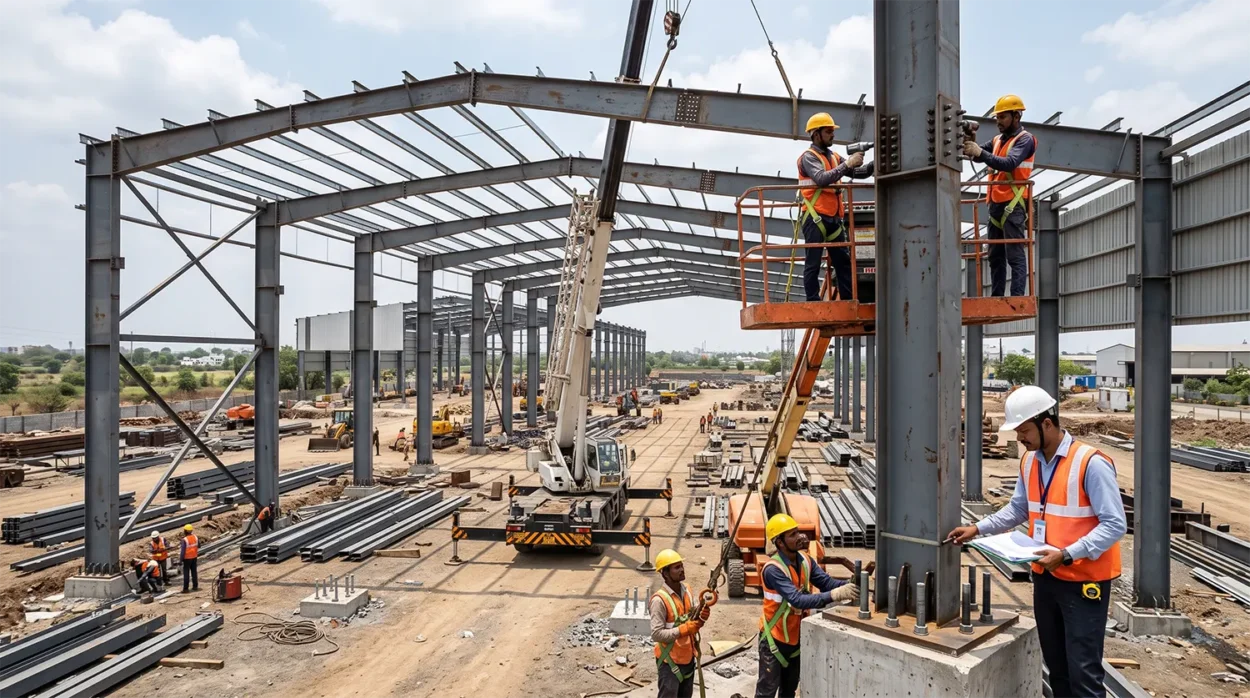
A well-designed frame fabricated from the right steel can still underperform if erection tolerances are sloppy – misaligned bolts, under-torqued connections, or bracing installed out of sequence. Steel prices have risen sharply in recent construction cycles, pushing overall PEB costs up by 25% or more during volatile periods, which tempts some vendors to cut erection crew size or supervision to protect margins.
The practical check: ask who supervises erection on-site – a qualified site engineer employed by the manufacturer, or a subcontracted labor gang with no direct accountability to the fabricator. Ask for photographic quality-control records from a recent, comparable project.
Metal Tree deploys its own site engineering team for erection supervision on every project, with a documented quality checklist at each stage – foundation bolt verification, column plumb checks, and connection torque records – rather than handing the final, most consequential phase to an unsupervised third party.
Mistake 7: Ignoring Track Record, References, and After-Sales Support
The India PEB market is projected to grow from roughly $1.84 billion in 2024 to $3.93 billion by 2030 at a 13.5% CAGR – and a rising share of that demand is coming from first-time PEB buyers who don’t yet know which questions to ask a vendor about long-term support.
A structure’s warranty is only as good as the company standing behind it years later. Ask for at least two verifiable completed projects of comparable scale you can actually visit or call the owner about – not a stock photo gallery. Ask what happens if a coating issue or connection problem shows up in year six. Metal Tree stands behind every project with documented after-sales support and a transparent warranty structure, because the real test of PEB quality standards isn’t the handover day – it’s how the building performs a decade in.
Frequently Asked Questions
Reputable PEB companies in India typically specify IS 2062 grade structural steel with documented yield strength and mill test certificates. Buyers should always request the steel grade and source mill in writing – a quote that lists only “structural steel” without a grade is a warning sign.
PEB structures in India should be designed to IS 875 (Part 3) for wind loads, IS 1893 (Part 1) for seismic loads, and IS 800 for general steel construction. A project-specific load calculation report, not a generic template design, is standard practice for a compliant PEB manufacturer.
Hot-dip galvanized steel can last 40 to 70 years with minimal maintenance versus a 5–10 year repaint cycle for standard primer systems, making it the stronger choice for coastal, humid, or chemical-exposure sites. Painting remains a valid, cost-effective option for indoor or low-exposure architectural steelwork.
Compare the technical specification annexure, not just the commercial price – steel grade, applicable IS codes, coating system and thickness, and warranty terms should all be documented in writing. A lower quote missing these details usually means a lower-spec building, not better value.
Ask for mill test certificates, project-specific wind and seismic load calculations, the coating system rated for your site’s exposure zone, and at least two verifiable completed projects you can inspect. Metal Tree provides all of this upfront as part of its standard proposal process.
Metal Tree is a Pre-Engineered Building manufacturer based in India, specializing in IS-code compliant steel structures for industrial, warehousing, and commercial projects. Every quote includes a full technical specification annexure – steel grade, design codes, coating system, and warranty terms – before you sign.