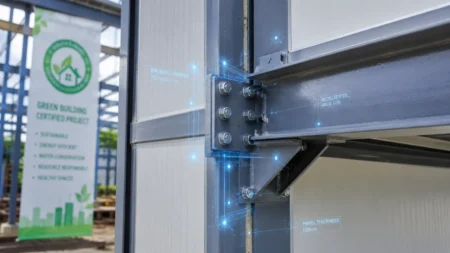
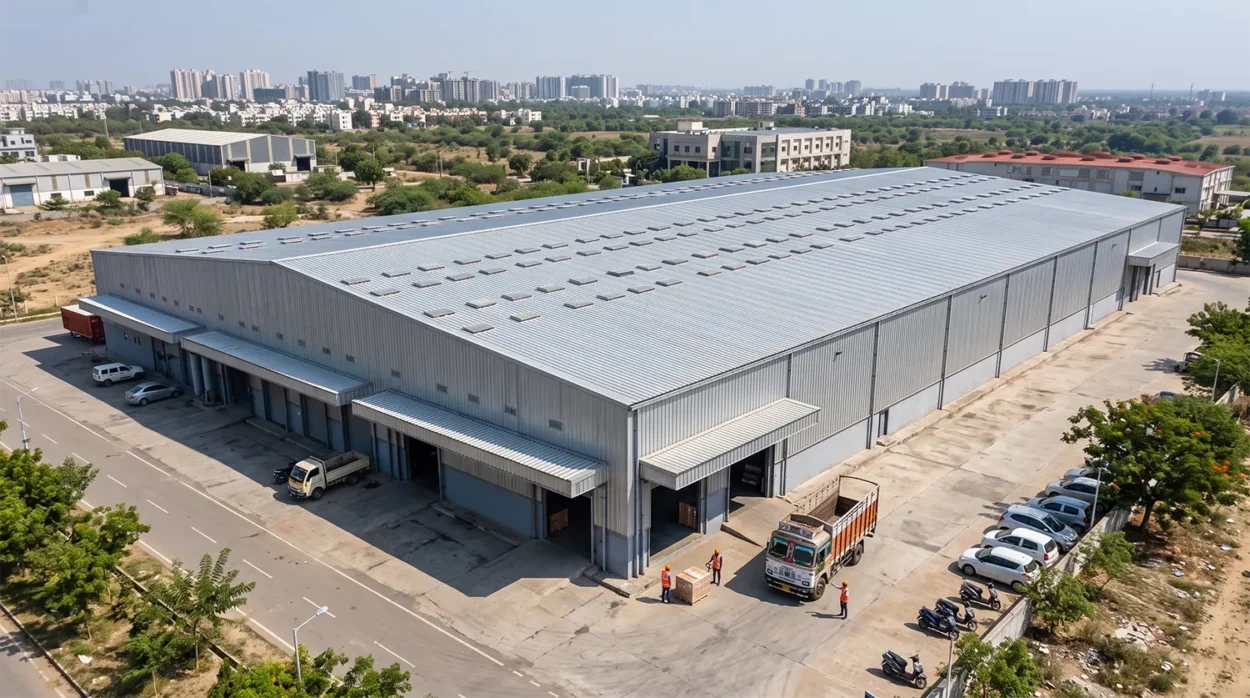
Choosing the wrong roofing sheet for your pre-engineered building can cost you far more than the sheet itself. A basic warehouse fitted with unnecessary insulation burns cash upfront, while a cold storage unit built with bare Galvalume sheets can lose an entire batch of perishable stock to a single hot afternoon. The India pre-engineered buildings market is on track to grow from USD 2.26 billion in 2025 to USD 6.46 billion by 2034, expanding at a 12.38% CAGR.
More sheds are going up than ever, and more buyers are getting this one decision wrong.
This guide breaks down exactly when bare Galvalume roofing sheets make sense and when insulated PUF or EPS panels are worth the extra investment. It’s written by Metal Tree, a pre-engineered building manufacturer based in Greater Noida, Uttar Pradesh, that fabricates and installs both bare Galvalume roofing systems and insulated PUF/EPS sandwich panels for PEB wall cladding and roofing across India.
Key Takeaways
- Bare Galvalume sheets suit dry warehousing, godowns, and non-climate-sensitive sheds; they cost roughly 30-40% less per sq ft than insulated panels.
- PUF and PIR sandwich panels reduce HVAC energy load by up to 40-50% in temperature-controlled buildings .
- Galvalume’s aluminum-zinc-silicon coating resists corrosion 2-4 times better than plain galvanized steel and can last 40-50+ years.
Metal Tree supplies PUF panels from 40mm to 160mm thick, with a U-value as low as 0.28 W/m²K, for cold storage and food-grade PEB projects.
What Is a PEB Roofing Sheet, and Why Does the Material Choice Matter?
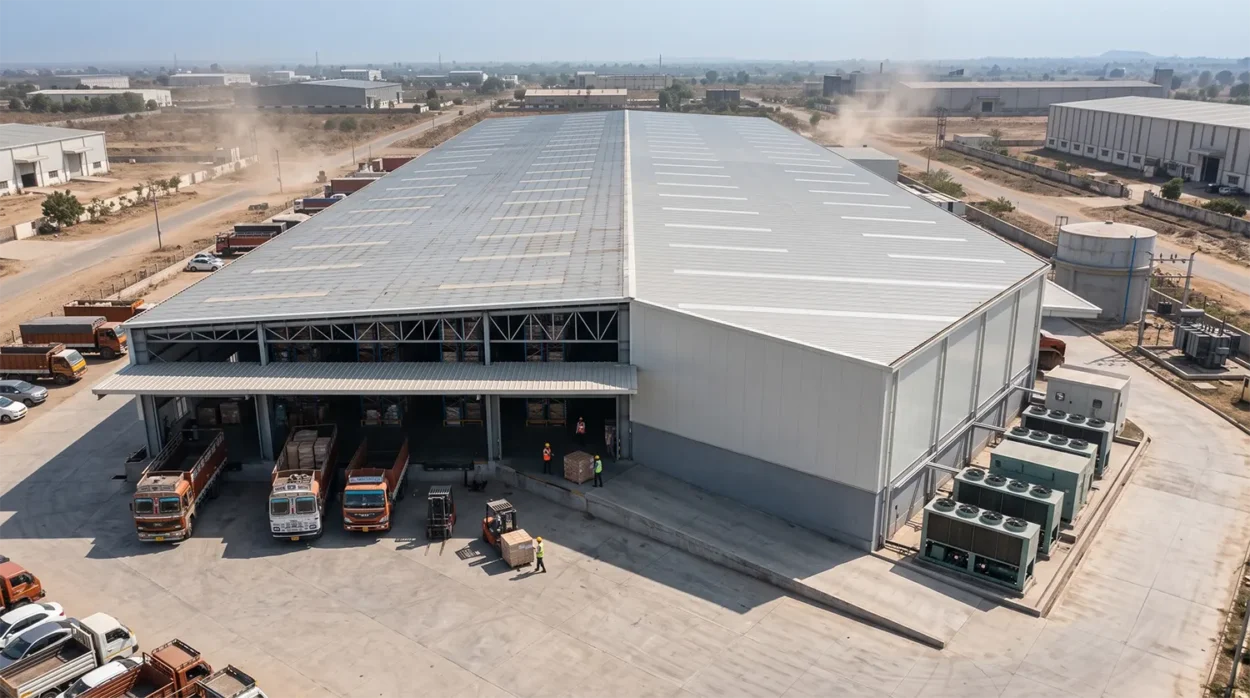
A PEB roofing sheet is the outer metal skin that closes a pre-engineered steel structure – the same steel frame can carry either a single bare metal sheet or a fully insulated sandwich panel. That single fork in the design decides your energy bill, your product shelf life, and your total project cost for the next 20-30 years.
Most Indian buyers assume “roofing sheet” means one product. It doesn’t. On one end sits bare Galvalume – a single layer of coated steel with zero insulating value. On the other sits a PUF or EPS sandwich panel – two metal skins with a rigid foam core in between, doing double duty as both roof/wall cladding and insulation. Everything in between (fire rating, acoustic performance, condensation control) flows from that core material.
Buyers who pick their roofing system based on climate zone alone – rather than what’s stored or manufactured inside – routinely oversize their insulation budget for dry-goods warehousing, or undersize it for anything involving refrigeration.
Bare Galvalume Roofing Sheets: Composition, Lifespan, and Best-Fit Use Cases
Bare Galvalume roofing sheets are cold-rolled steel coated with roughly 55% aluminum, 43.5% zinc, and 1.5% silicon, giving them corrosion resistance two to four times better than plain galvanized steel. No foam core, no wall cladding function – just a durable, reflective, single-skin metal sheet.
The aluminum layer forms a long-term barrier against rust while the zinc component sacrificially protects any exposed edges where the sheet has been cut or scratched – engineers call this “self-healing” behaviour. Under normal atmospheric exposure, industry data shows Galvalume roofing can last 40 to 50-plus years without significant corrosion
Bare Galvalume works best for:
- General industrial warehouses and godowns storing non-perishable goods
- Logistics and distribution sheds with ambient temperature tolerance
- Vehicle parking sheds, workshops, and equipment storage
- Budget-driven projects where speed and low capex outweigh insulation needs
- Dry manufacturing units that don’t generate process heat or humidity loads
Across Metal Tree’s warehouse projects in Delhi NCR and western UP, bare Galvalume roofing remains the default specification whenever the client’s stored goods have no temperature sensitivity – it is, quite simply, the fastest way to close a building envelope.
One caveat: ammonia exposure chemically attacks the aluminum in the Galvalume coating, so buildings near livestock housing or ammonia-based refrigeration plants may still need plain galvanized steel in specific zones.
PUF Panels and PEB Wall Cladding: How Insulated Sandwich Panels Work
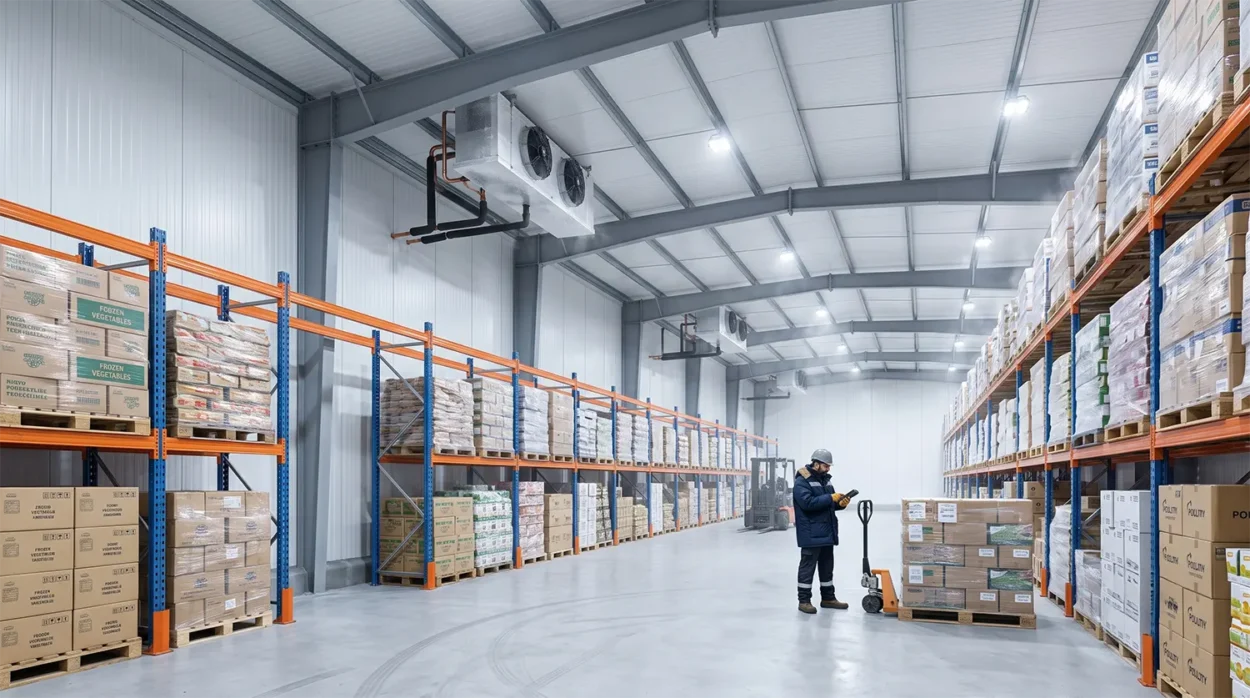
PUF (Polyurethane Foam) panels are pre-fabricated sandwich units – two pre-painted metal skins bonded to a rigid, closed-cell polyurethane foam core – used for both PEB roofing and PEB wall cladding wherever thermal insulation, hygiene, or fire safety are non-negotiable. The foam core achieves a thermal conductivity as low as 0.022-0.024 W/m·K, among the lowest of any commercial insulation material.
The closed-cell foam structure traps millions of microscopic air pockets, which is what actually blocks heat transfer rather than the metal skins themselves. Because the insulation and the structural cladding are the same component, a PUF panel roof does the job of two separate materials in one factory-fabricated piece – cutting site labor and installation time considerably compared to built-up insulation systems.
As a PUF panel manufacturer, Metal Tree fabricates panels from 40mm to 160mm thickness, using 0.47mm pre-painted Galvalume steel skins on both faces, with U-values as low as 0.28 W/m²K depending on thickness and application. For fire-critical zones, we also supply Rockwool-core panels; for acoustic control in offices and auditoriums, Glasswool-core panels round out the range alongside the more budget-friendly EPS option.
PUF/EPS panels earn their premium in:
- Cold storage rooms, blast freezers, and ripening chambers
- Food processing and food-grade manufacturing plants requiring hygienic, wash-down surfaces
- Pharmaceutical clean rooms and temperature-controlled warehousing
- Any factory running HVAC systems that need to hold a stable internal temperature
- Buildings where sound insulation or fire-rated compartmentation is mandated
Bare Galvalume vs. PUF Panels: Side-by-Side Comparison
The decision comes down to five variables: insulation, cost, installation speed, fire performance, and what’s actually stored inside the building.
Bare Galvalume Sheet ~50+ (no core insulation)
EPS Sandwich Panel ~0.035-0.040 W/m·K
PUF Sandwich Panel ~0.022-0.024 W/m·K
PIR Sandwich Panel ~0.018-0.022 W/m·K
| Parameter | Bare Galvalume Sheet | PUF/EPS Sandwich Panel |
| Insulation | None (thin metal skin only) | Thermal conductivity 0.022-0.040 W/m·K |
| Best for | Basic warehousing, godowns, workshops | Cold storage, food processing, temp-controlled factories |
| Indicative cost premium | Baseline | ~30-50% higher per sq ft than bare sheet |
| Installation | Single sheet, fastest to lay | Factory-fabricated panel, still faster than brick insulation |
| Corrosion resistance | 2-4x better than galvanized steel | Same Galvalume facing, plus foam core protection |
| Service life | 40-50+ years | 20-30 years |
| Fire performance | Non-combustible steel | PUF combustible; PIR/Rockwool cores are fire-rated |
| Energy impact | None – full heat transfer | Cuts HVAC load by up to 40-50%. |
When to Use Bare Galvalume: The Basic Warehousing Scenario
Choose bare Galvalume roofing sheets when your building doesn’t need to fight the outside temperature to protect what’s inside. A dry-goods warehouse, a spare-parts godown, an equipment yard shed, or a vehicle workshop rarely needs anything beyond a weatherproof, corrosion-resistant skin.
This is also the right call when construction budget and speed dominate the decision. Bare sheet roofing is lighter, cheaper per square foot, and goes up faster than any insulated system – which matters when a client needs a 20,000 sq ft shed operational within weeks, not months. Metal Tree typically erects a 5,000-20,000 sq ft PEB warehouse in 8-14 weeks from order confirmation, and a bare-shell specification is usually the fastest path through that timeline.
Don’t force insulation onto a building that doesn’t need it. Every extra rupee spent on a PUF panel over a Galvalume sheet, in a shed that never needs climate control, is a rupee that didn’t need to leave the project budget.
When to Invest in PUF/EPS Panels: Cold Storage, Food Processing, and Temperature-Controlled Factories
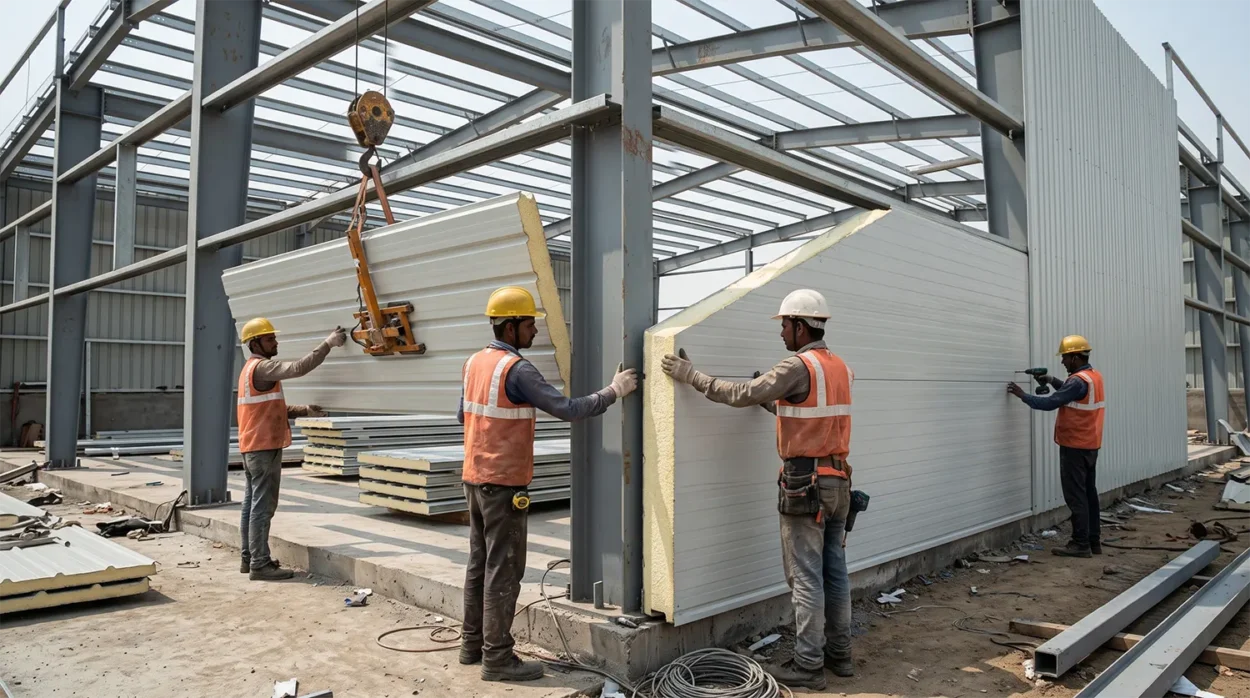
Choose insulated PUF or EPS panels the moment your building’s job includes holding a temperature, not just holding a roof over goods. Cold storage, blast freezers, and ripening chambers cannot function without a continuous thermal envelope – a single thermal bridge lets heat migrate in and your refrigeration compressors run harder, longer, and less efficiently.
India needs an estimated 50,000-plus new cold storage facilities to keep pace with food production, and the cold storage industry itself is growing at roughly 12.3% CAGR through 2028. That buildout is running almost entirely on PUF-panel construction, because traditional brick-and-mortar cold rooms take months to build against a PEB’s weeks.
Food processing and food-grade manufacturing plants have a second, separate reason to specify insulated panels: hygiene. PUF and EPS wall cladding gives a smooth, wash-down, joint-sealed interior surface that resists moisture and bacterial growth – something a bare sheet interior simply can’t offer under FSSAI-grade hygiene audits.
On Metal Tree’s own PUF panel line, 60mm-80mm thickness covers most ambient-to-chilled cold storage requirements, while blast freezers and deep-freeze rooms typically call for 100mm-150mm panels to hold sub-zero internal temperatures economically.
Pharmaceutical clean rooms, dairy processing units, and any factory running continuous HVAC to hold a set internal temperature belong in this category too – the insulation premium pays for itself in reduced compressor and HVAC running costs within a few years of operation.
Cost and ROI: Is the PUF Panel Premium Worth It?
PEB construction in India typically runs ₹1,200-2,500 per sq ft depending on span, height, and insulation choice – a basic uninsulated industrial shed starts around ₹1,200/sq ft, while an insulated warehouse specified with sandwich panels runs ₹1,800-2,200/sq ft. That 30-50% premium buys three things: lower ongoing energy costs, tighter temperature control, and a longer effective service life for whatever is stored inside.
Run the math on your specific use case before deciding. A dry-goods godown gets zero return from that premium. A cold storage facility or food processing plant recovers it through lower compressor run-time and reduced spoilage within the first two to three years of operation – after which the energy savings of up to 40-50% go straight to the bottom line.
How Metal Tree Helps You Choose the Right PEB Roofing and Wall Cladding System
Metal Tree designs every PEB structure to IS 800:2007, IS 875 (wind and snow loads), and IS 1893 (seismic design), using STAAD.Pro and dedicated PEB design software – so whichever roofing system you choose, the underlying steel frame is engineered for your site’s actual wind and seismic zone, not a generic template.
As a PUF panel manufacturer and Galvalume roofing supplier under one roof, Metal Tree can quote both systems side by side for your project – including EPS, Rockwool, and Glasswool core options for PEB wall cladding – so you’re comparing real numbers, not guessing. If you’re still weighing PEB against traditional RCC construction for your next facility, that comparison is worth reading before you lock in a roofing spec. And if your project also needs a broader look at where prefabricated construction in India is headed in 2026, our latest industry trends post covers that ground.
Explore Metal Tree’s full range of insulated sandwich panels or get a quote for your PEB warehouse or PEB factory building project. Our engineering team can walk you through the Galvalume-vs-PUF decision for your specific site, span, and storage requirement – contact Metal Tree to get started.
Frequently Asked Questions
It depends on what’s stored. Ambient dry-goods storage (grains, packaged FMCG, non-perishables) works fine under bare Galvalume. Anything requiring temperature control or hygienic wash-down surfaces – cold storage, dairy, meat processing – needs PUF or EPS panels instead, since bare sheet offers no thermal insulation
Most chilled cold storage rooms use 60mm-80mm PUF panels, while blast freezers and deep-freeze applications typically need 100mm-150mm panels to maintain sub-zero temperatures efficiently. Metal Tree manufactures PUF panels from 40mm to 160mm thick with U-values as low as 0.28 W/m²K, and recommends thickness based on your target internal temperature and ambient climate zone.
Bare Galvalume roofing sits at the lower end of PEB construction costs, around ₹1,200/sq ft for a basic uninsulated shed, while PUF/EPS insulated systems typically add a 30-50% premium, landing around ₹1,800-2,200/sq ft depending on panel thickness and core material. Exact pricing varies by site, span, and current steel prices.
Both use the same Galvalume-coated steel facing, so corrosion resistance is comparable on the metal skin itself. Galvalume’s aluminum-zinc-silicon coating resists corrosion 2-4 times better than plain galvanized steel and can last 40-50-plus years under normal conditions. PUF panels add a foam core for insulation, not extra corrosion protection.
Yes. Metal Tree manufactures and supplies both bare Galvalume roofing sheets and PUF, EPS, Rockwool, and Glasswool sandwich panels, so a single warehouse can mix zones – bare sheet over general storage areas and insulated PUF panels over a cold room or processing section – under one PEB structural frame and one point of contact.